Module 7 - Incorporating the Interrogator Unit
Introduction
This is a modular manual element that is used in the OS6 Administrator’s Manual, FAT Manual and Installer’s Manual.
It can be used for:
- Identifying and preparing an IU for deployment
- Replacing a faulty IU
- Fully commissioning an IU from scratch
Depending on the nature of the activity being considered some or all this manual may be required.
The manual is presented in the typical order required for a full set up from new of an IU, if an IU is being replaced into an existing configuration, users should take care with any setup that is being modified related to the configuration.
For example, if a fibre length is already known and used, exploiting the auto length detection routines may adversely affect the existing config and it is advised to stick with the existing configuration length.
Prior to using this manual, the user should be familiar with all IU maintenance aspects covered in the relevant product User Manual.
The user will also require the individual Interrogator Unit User Manuals for full detail on deploying and maintaining an Interrogator Unit
Laser Radiation Safety Notes
Luna® Interrogator Units include laser products, these are classified in accordance with 21 CFR 1040.10 and IEC 608251. Please note the warnings in this document and attached to the unit, reproduced below – a typical example is shown below.
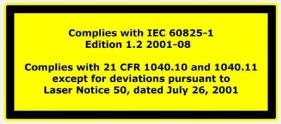

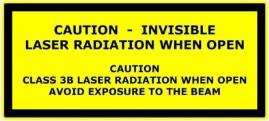

Use of controls or adjustments or performance of procedures other than those specified herein may result in hazardous radiation exposure.
In normal operation, the light emitted by a Luna IU is completely contained within an optical fibre. The user must ensure appropriate controls (for example those described in IEC 608252) are in place to prevent unauthorised personnel breaking the continuity of the fibre, causing emission of invisible laser radiation.
Always switch off Laser Enable Keyswitch and remove the key before disconnecting or breaking the continuity of the fibre.
Do not operate a Luna® IU without an optical fibre connected.
Prior to connecting fibre always clean and inspect the connectors.
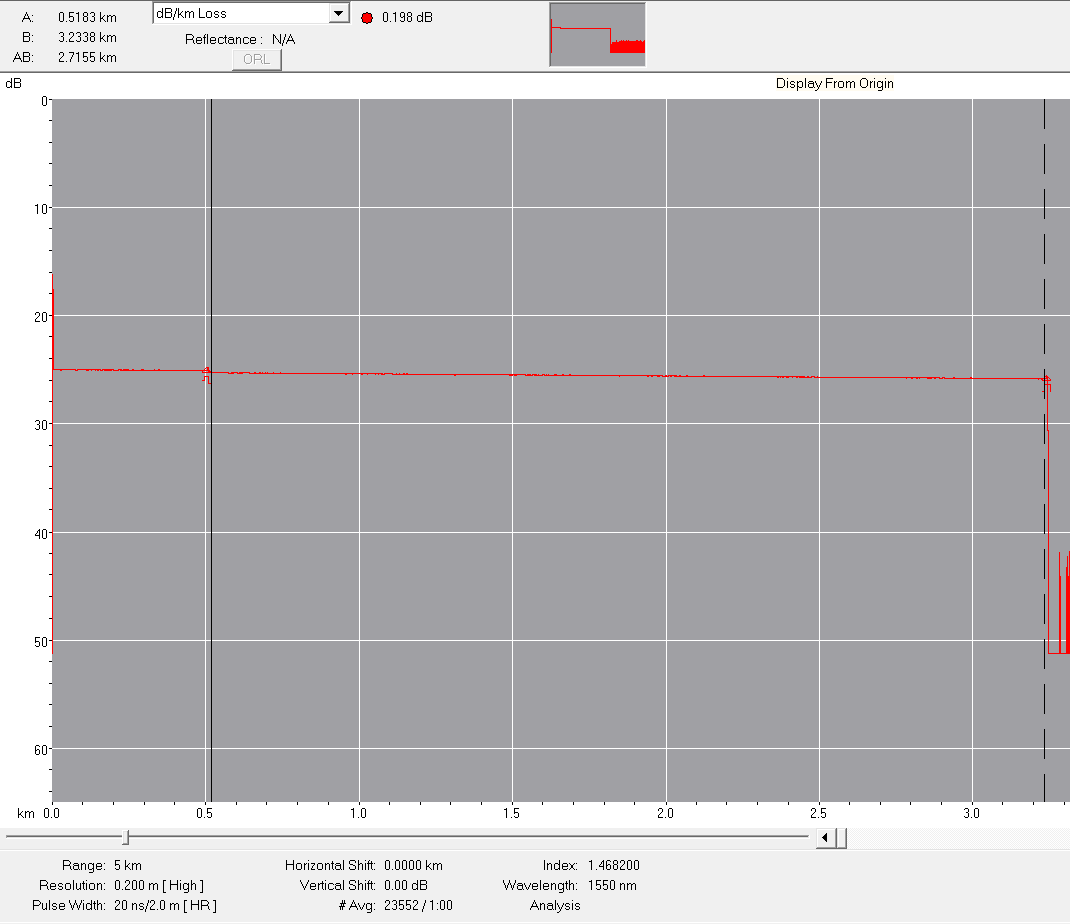
Consult an OTDR reading on a new connection prior to turning on and ensure that the behaviour is in line with the Luna Fibre Acceptance Specification
Before turning on laser after a new fibre connection ensure that detectors are set to a maximum and follow the laser attenuation procedure detailed in this manual.
Consult the relevant IU Manual for operations and maintenance activities.
The lightning flash with the arrowhead symbol within an equilateral triangle is intended to alert the user to the presence of un-insulated ‘dangerous voltage’ within the product’s enclosure that may be of sufficient magnitude to constitute a risk of electric shock to persons.
Care must be taken whilst handling any of the equipment described in this manual. If any equipment is suspected to having been poorly handled, it must not be used before an adequate inspection can be made and continued safe operation verified.
Introduction to the Luna Family of Interrogator Units
The Interrogator Unit (IU) is a core piece of equipment in the Luna OS6 stem. It probes the fibre and delivers measurement data to the Processing Hardware.
Most devices used in the Luna OS6 software are the OLA2.1(+) series of interrogators, however other units may also be encountered:
- OLA2.1(+) - The current “standard” Intensity only Interrogator Unit
- OLA2.2 – An Intensity only Interrogator Unit which can connect to two separate fibres using single laser. Both fibres will be displayed on the Backscatter plot simultaneously, as the IU has a single laser monitoring both fibres
- ODH-F – A quantitative IU that builds on prior Interrogator Unit developments. Can also operate in a similar mode to the OLA2.1 units and is intended to be able to flexibly deliver similar performance levels to the OLA2.1 although it is NOT intended to replicate it.
- QuantX - The QuantX system has been developed specifically to address sensing applications which require high quality quantitative phase and amplitude output and the practical levels of asset coverage whch were previously only available with a qualitative distributed acoustic sensing solution or over short ranges.
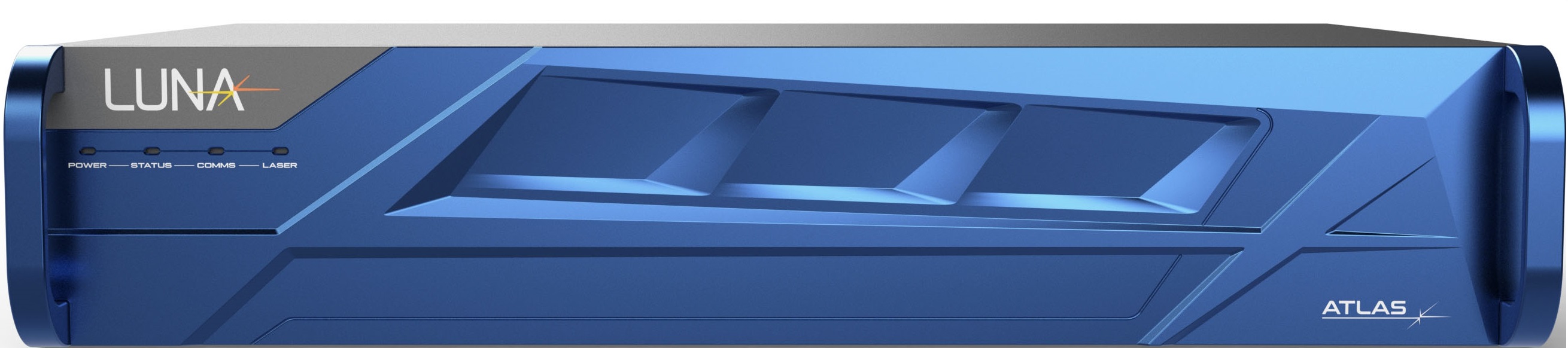
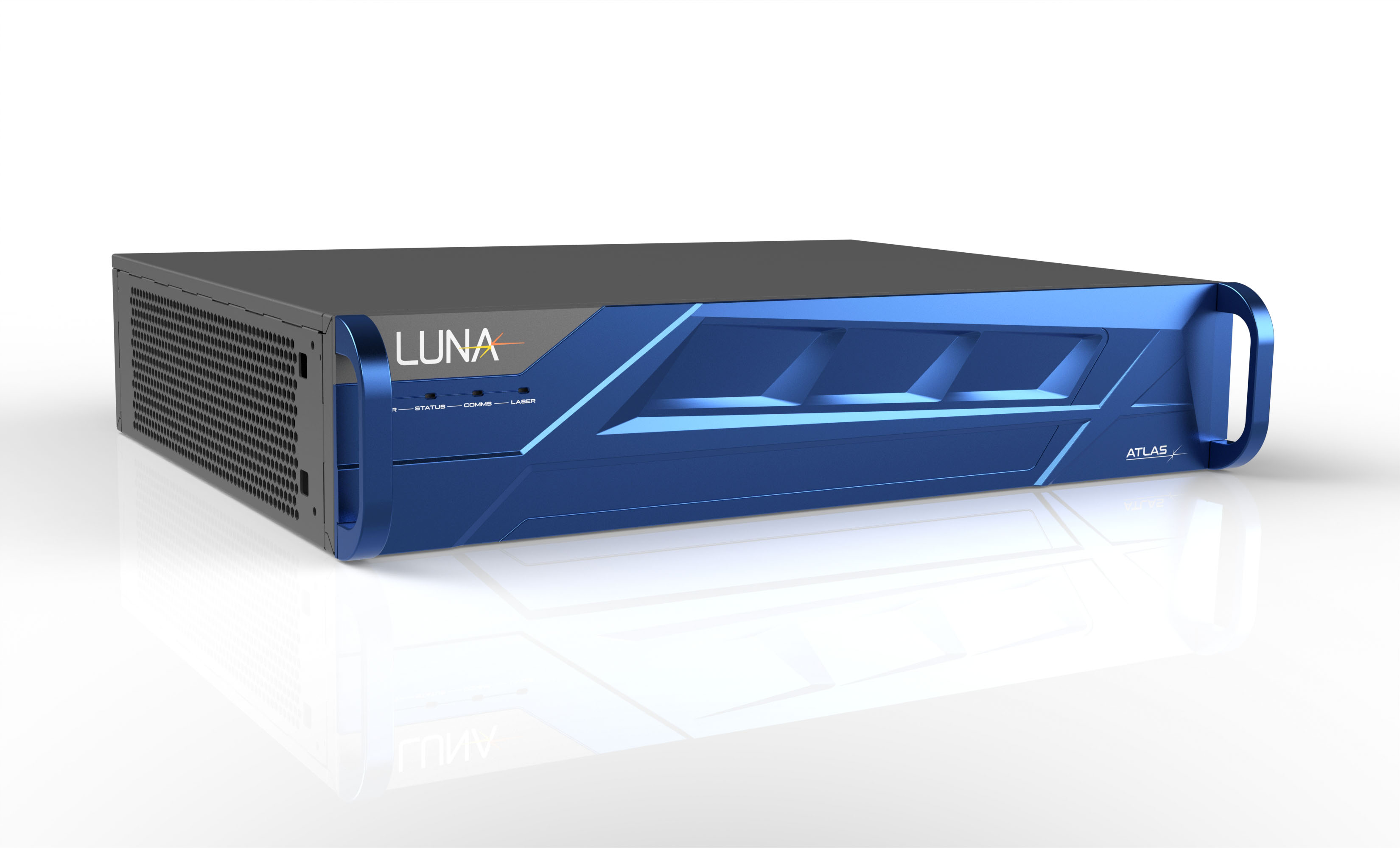
- ATLAS - The Atlas IU has been developed as the successor to the QuantX IU and greatly reduces the size, weight and power requirements while maintaining the high quality quantitative phase and amplitude output at extended ranges. The Atlas IU also supports simultaneous interrogation of dual-fibre (or quad-fibre) configurations.
Further information on the IUs can be found in the Luna System Specification, datasheets, and IU User Manuals.
Installing the Interrogator Unit
For all installation and usage information please consult the individual IU User Manuals. Failure to follow these instructions may invalidate your warranty.
Connecting to the Sensing Fibre
Preparation of Near End of Fibre
The IU is fitted with an E2000-APC female receptacle on the rear of the unit. The preferred method of connecting to a fibre is by splicing an E2000-APC pig tail or patch cable directly on to the sensing fibre and inserting into the rear of the IU.
Where a direct splice cannot be made and a patch panel is to be used, it is recommended to connect with a minimum 30m patch cable between the IU and the patch panel. The connections on the patch panel should also be of an APC variety.
Use of any connectors not approved by Luna is done at the client’s own risk, which may cause significant damage to the IU, would invalidate any warranty and may result in a loss of system performance. Contact Luna prior to any fibres being attached to the system and the IU’s laser being switched on. The OTDR traces must be supplied to Luna once the Termination Units and E2000/APC connectors have been attached.
It is important that before connecting to any new or unfamiliar fibres, an OTDR trace is measured to assess the conditions of the fibre and ensure that there are no significant reflections over the fibre.
Please ensure that all connected fibres match the requirements of Luna Fibre Acceptance Specification prior to connecting.
- Prior to connecting fibre ensure that the laser enable key switch is in the OFF position, attenuators are set to maximum and the key is removed.
- For optimum performance and particularly for short fibre lengths (<10 km) it is recommended that a Luna termination unit is fitted to ensure there is no end reflection.
- DO NOT insert a dirty or damaged optical fibre connector into the IU as this may contaminate or damage the internal connector.
- The Luna IU is fitted with a fully enclosed E2000-APC type connector which does not need service cleaning during normal operation.
- Direct splicing of the sensing cable into a patch panel is the preferred arrangement; however, should a splice connection not be possible, connection via APC patch cords may be used, each of which MUST be at least 30m length.
Verifying the End Condition with a Fibre Scope
The fibre scope must be used to check the cleanliness of any IU E2000 connector or E2000 patch cord connector. This task must be performed before connection any IU to any fibre even if the IU has come directly from the manufacturer.
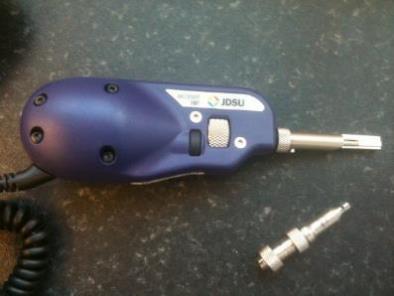
Before using the fibre scope the following is needed:
- The fibre scope.
- A laptop with “FibreCheck 2” installed this can be found on the disc located with the fibre scope or on your field engineers HDD. To install FibreCheck insert the disc and follow the on-screen instructions.
There are two types of connector to be used to check the patch leads and the IU E2000 connectors

Once the right connector has been screwed onto the fibre scope the connector can then be tested.
Attach the fibre scope to a laptop via a USB port and start the FibreCheck 2 software. Ensure that the fibre type is set to single mode (SM) (See Figure below)

Push the fibrescope onto the E2000 patch lead connector or E2000 IU connector.
Push the small button located next to the focus wheel on the fibrescope to activate the camera. Confirm that an image comes up in the FibreChek2 software.
Use the focus wheel to bring the connector in to focus and once the percentage in the bottom right hand corner goes above 35% press the “Test Fibre” button on the software to take a picture of the fibre core.
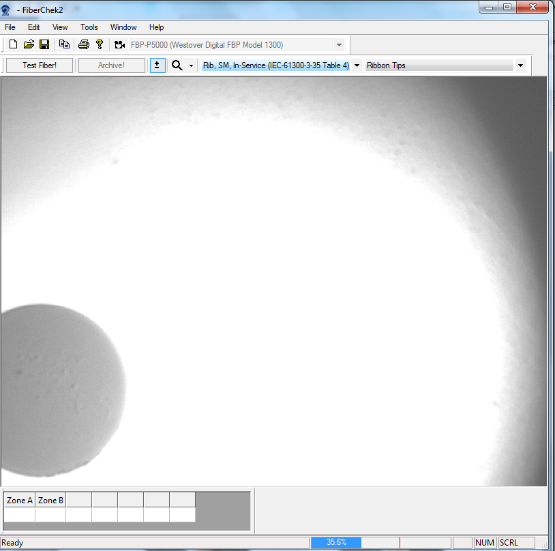
The FibreCheck software will then process the image and return a pass or fail.
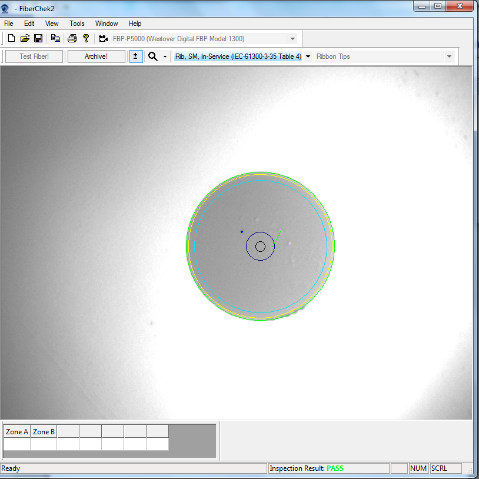
If a pass is achieved the fibre end is ready to be used. If a fail is achieved, then the Fujikura One Click should be used to clean the connector and the process should be followed again to check the fibre.
An image of the condition should be saved to verify that the system was correct on inspection.
If the fibre check continually fails do not use the IU or patch cord. These items should be isolated and given to the engineer running the FAT to ensure that further testing/cleaning is carried out and as a last resort sent back to the manufacturer for replacement or repair.
Preparation of Far End with Termination Unit
The fibre termination unit is a bespoke development designed to eliminate reflections from the end of fibre termination. It should be spliced on to the end of the sensing cable to suppress end reflections.
The marked unit can be placed inside the patch panel and needs no further treatment.
| Specification | Single mode termination unit |
|---|---|
| Length | 150mm |
| Connection Type | Fibre pigtail (direct splice) |

Making the Final Fibre Connection
All the fibre connectors once cleaned can be connected using the methodology appropriate to the specific connectors. In the case of the Luna E2000 connectors, the connector block should be guided into the matching receptacle on the rear of the IU and pushed home until a positive click is heard / felt. Some modest resistance may be experienced, and this will need to be overcome until the connection fully latches home.
To connect the fibre, remove the protective dust-cap by simply pulling the tab to withdraw it. Insert the connector immediately and check that it clicks into position. When removing the fibre, replace the dust cap immediately to prevent contamination of the IU output connector.
Do not operate the IU without an optical fibre connected. Following the procedures in this manual and taught during training will ensure that the laser is only switched on when safe to do so.
Only disconnect or break the continuity of the optical fibre with the Laser Enable Keyswitch turned to the off position (the Laser Enable LED will be off) and the key removed.
Preparing the IU For Service
All Interrogator Units use the same software interface. Some IU specific features are different and will be noted where required.
Consult the IU specific manuals for further information.
The process for setting up the lasers follows a few discrete steps:
- Changing the IP address of the IU (if required)
- Verify that there are no reflections present in the fibre which could cause damage to the system or degradation of signal
- Set the fibre length, sample rate, resolution and verify position of end of fibre
- Optimise power density of the signal present in the fibre to achieve maximum signal to noise ratio whilst ensuring the system is operating in a linear manner. Too great a power density (low launch attenuation) will deliver non-linear performance resulting in degraded performance at longer ranges.
- Manually verify the auto attenuation settings
Before switching on the laser for the first time it is vital to ensure that the IU is in a safe state. This is achieved by setting both the launch and detect attenuators to maximum.
Identifying the IP Address of the IU
There are two separate procedures for connecting a new IU. The procedure taken is dependent on whether the IP address of the replacement IU is known or unknown. In the event that the IP address is unknown then this can be determined as detailed below.
IUs without an E-ink Display
To change the IP address of an IU with an unknown IP address:
- Connect a laptop or a PC directly to the IU with an Ethernet Cable using Ethernet Port 1 on the IU.
- Use IP locating software such as NMap or Wireshark to retrieve the IP address of the IU if the IP address is unknown. Make sure that the IP address of the laptop is as close so the suspected IP address of the IU as possible. The manufacturing default for the IU is 192.168.0.33. The address range is typically 192.168.XXX.XXX.
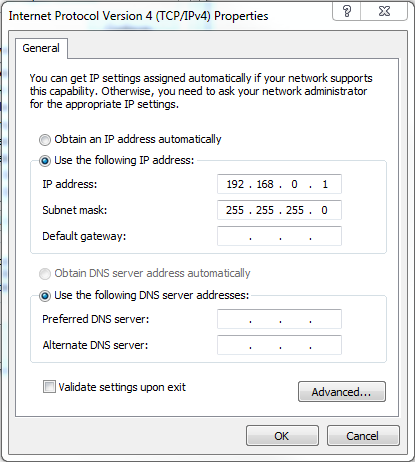
- Once the IP locating software has verified the IP address of the IU the standalone version of the IU setup tool can be run to change the IP address of the connected IU. The IP address of the laptop running this tool must be changed to allow connection to the IU’s existing IP address.
IUs with an E-ink Display
The IP address of an IU with a front-panel display can simply be read from the front panel. If the IU is turned on and displaying a different page, press the button to cycle through the information pages until it returns to the main information display.
Making an Initial Connection
Once you have confirmed the IU IP address and verified that you can communicate to it (e.g. by ping) then the IP address can be changed to the desired value.
For an IU that is being replaced or setup to a different sub net than that allowed on the actual configured system you may need to first change this externally, e.g. in a stand-alone laptop deployment.
Changing the IP address of an IU can be completed through the OS6 IU Setup tool. Open the IU setup, on the left-hand side of the OLA IU Setup main window select the OPS of the IU you require to change the IP address.
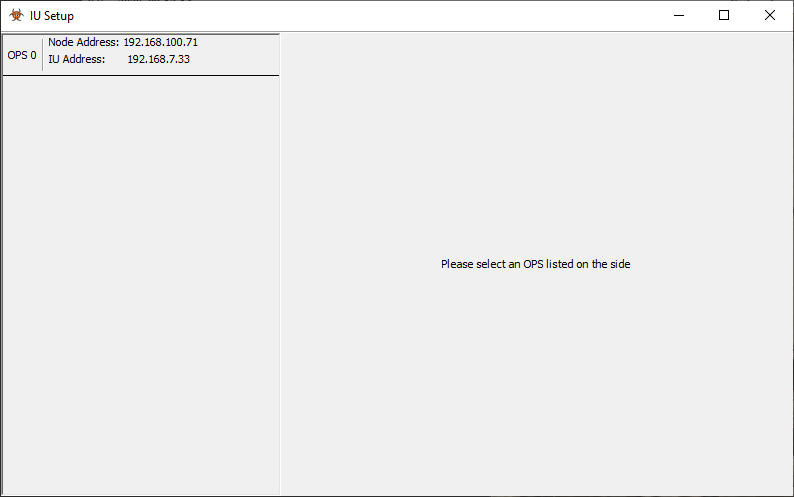
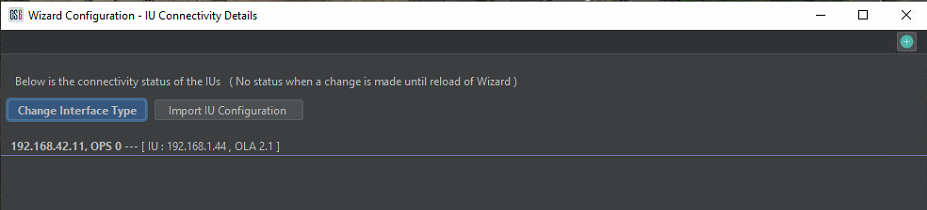
On first running its unlikely that the IU will have the IP address specified in your config, in this instance, you will need to confiugure IU Connectivity Details to choose the appropropriate IU type (OLA 2.1 / ODH-F / QuantX / ATLAS) and the IP address to connect to.
Changing the Address of the connected IU
Once the IU setup has connected to the IU the right window pane will be populated, and the ‘Connect’ button will be shown in green. To change the IP address, select the Edit button to the right of the IP.
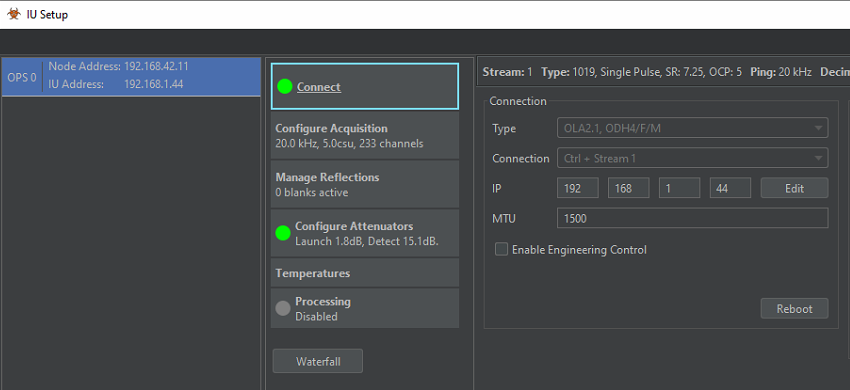
This brings up the Change IP Address window, enter the required IP address from the ND and ‘press OK’. It is then required to power cycle the IU. Once power has returned it is possible to check the IP address has changed on the front of the IU.

At this point you can either transfer the connection back to the processor using a stand-alone or continue, you may need to change the subnet IP address of your connected device.
Setting the IU into a safe condition before turning on the laser
The interrogator is fitted with two attenuators which act to decrease available length:
- Launch attenuator – decreases the amount of available light. Can be used to limit the light in a long fibre and ensure that operations are within the linear regime
- Detect attenuator – used to modulate the overall value in any deployment to ensure it is not limiting or clipping at the detector
Prior to setting the attenuators for the IU, the Interrogator must be placed into a SAFE mode to avoid damage.
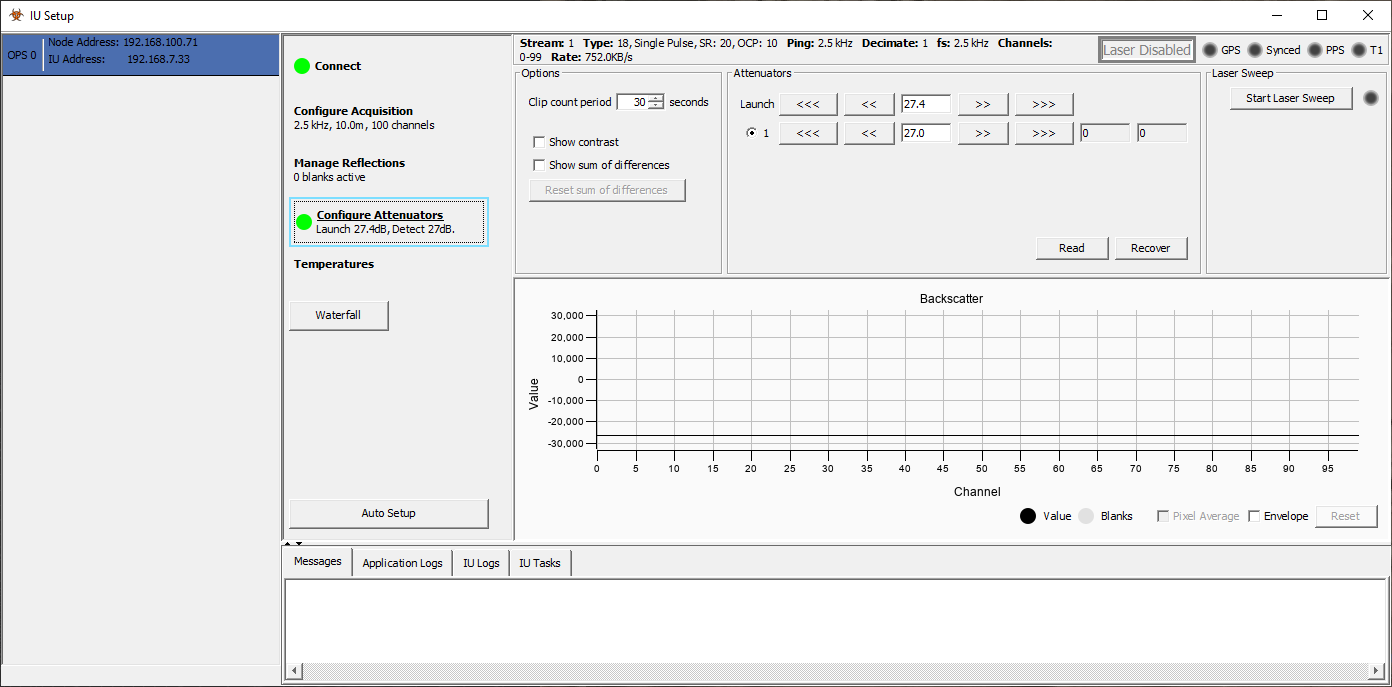
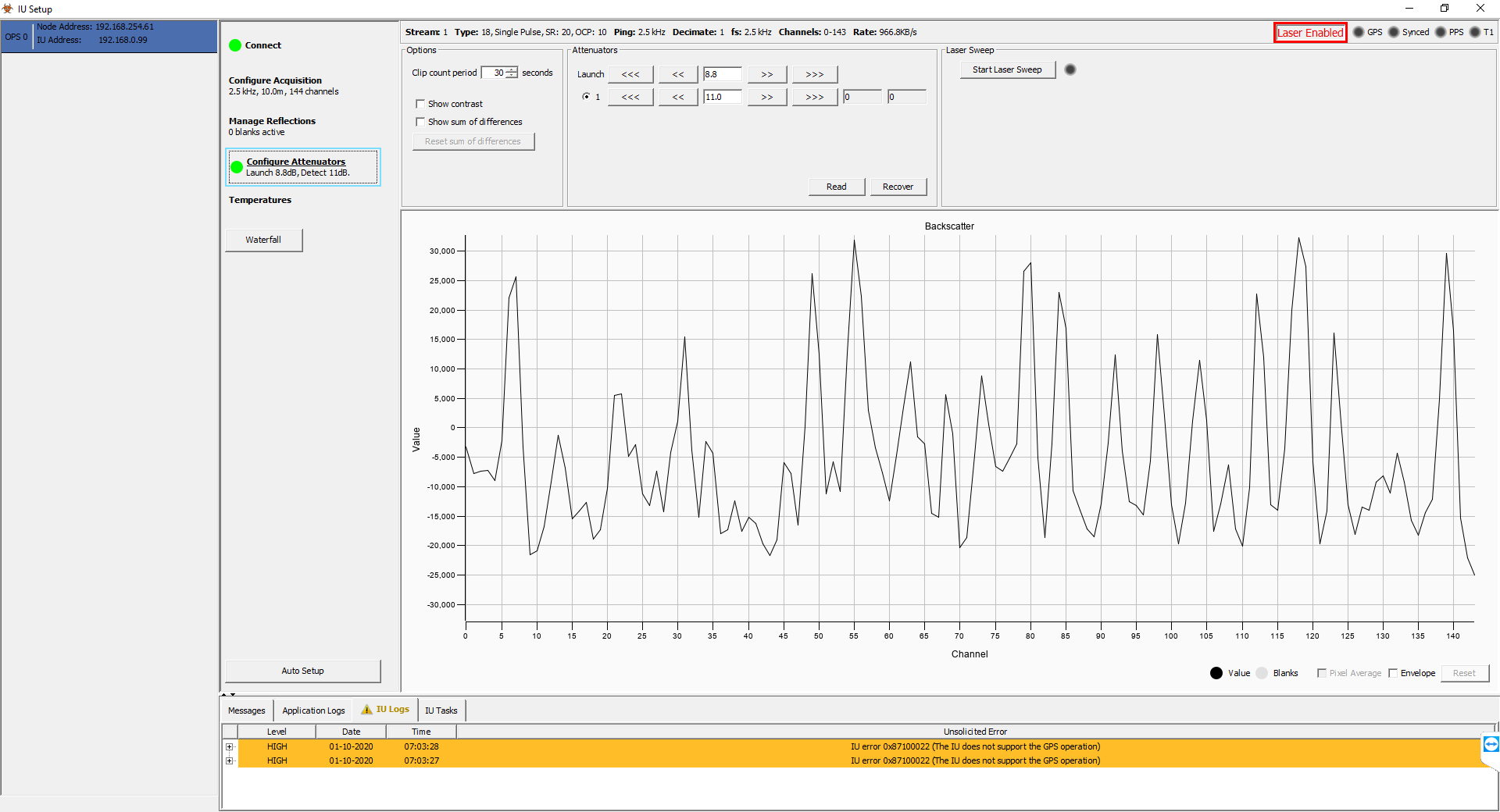
To do this, select the Configure Attenuators tab and set the attenuation to a high value (i.e. 40 dB). The IU will maximise its attenuation, which may be less than the entered value.
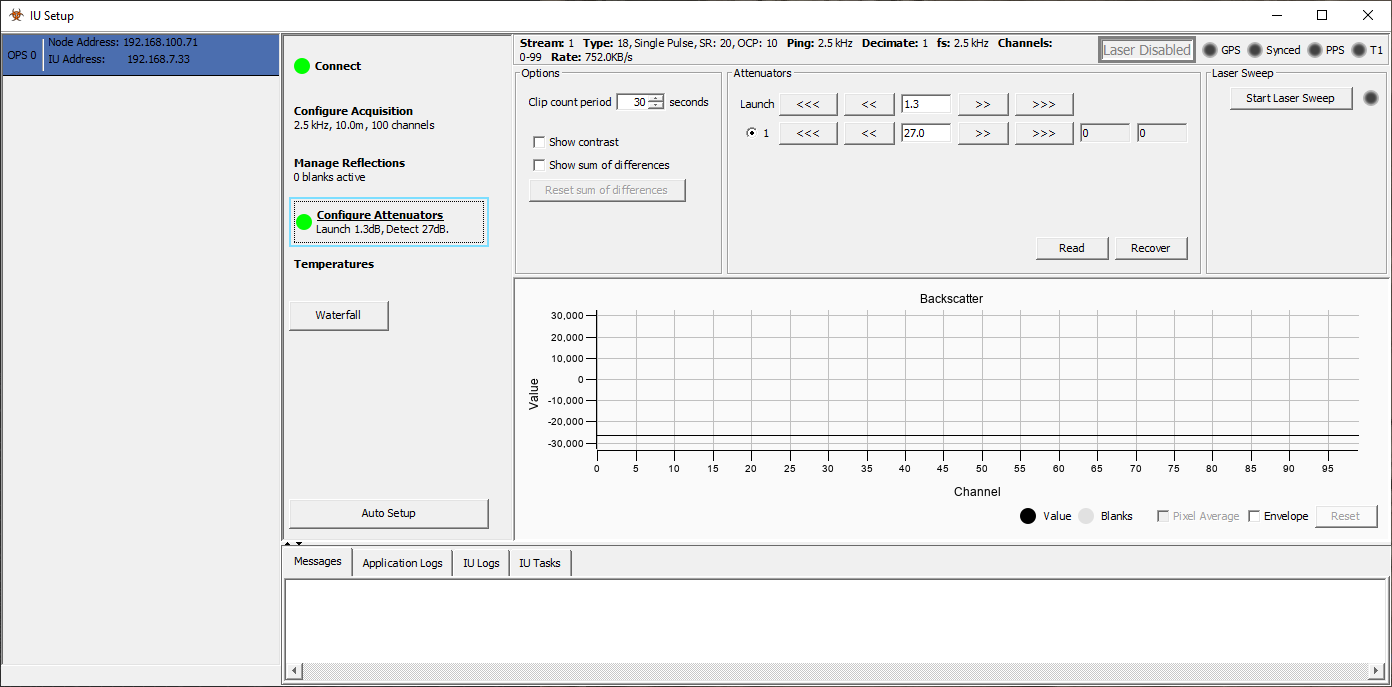
Once the launch and detect attenuation has been maximised and the fibre has been checked with an OTDR to confirm that there are no large reflections, the laser can be switched on at the IU (some IUs may have multiple physical keys).
Auto Setup Function
Some IUs have access to an auto-setup function that will choose the most appropriate configuration and launch/detect attenuation settings. Once the IU is connected the user can proceed to setup the IU using the Auto Setup button.
The Auto Setup function has been designed to acquire all the parameters needed for the successful setup of the IU. Requirements such as Data Type, Ping Rate, as well as Launch and Detect attenuation values will all be optimised.
When the Auto Setup button is actioned, the operator will be presented with the following dialog
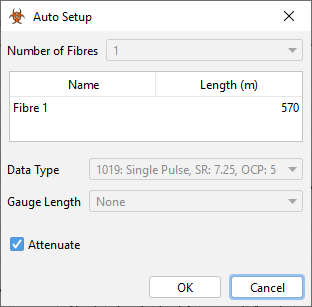
The operator is expected to to enter the fibre length in metres. This information should be known, if not the customer should have this information.
For OLA2.1(+) / QuantX the number of fibres cannot be changed and is set to ‘1’
For OLA2.2 a maximum of two fibres can be connected to this IU. If this is the case, select ‘2’ fibres and enter the two fibre lengths.
ATLAS IUs can handle 1, 2, or 4 fibres and should be set up accordingly.
In all cases the Auto Setup will select the ‘best’ Sample Rate and Data Type for the entered Fibre Length.
When the Auto Setup is running, a pulsing notifier will be present on the “Auto Setup” button which turns into an “Abort Auto Setup” button.

The Auto Setup tool is provided as an aide but should, in all situations, be verified by a competent, trained individual.
When the Auto Setup has completed and the final launch and detect attenuators have been set it is recommended that you monitor the Detector Clipping (on the Configure Attenuators tab) to ensure that the IU is not clipping above specification. Specifically, the start of the fibre near to the IU is most critical as excess clipping could damage the sensor. If an IU is clipping too much, then the traffic light will turn Red and emit ADC Clipping errors to the user. An amount of clipping is always to be expected and is normal. The detector statistics are monitored by the system.
When the detector clips excessively it will send an error to the GUI. Clipping will appear as a statistical variation; this does not imply there is a problem and can indeed be a positive indication that the IU is using maximum dynamic range. Where this becomes an issue is when clipping errors appear continuously, this indicates a serious problem that should be addressed.
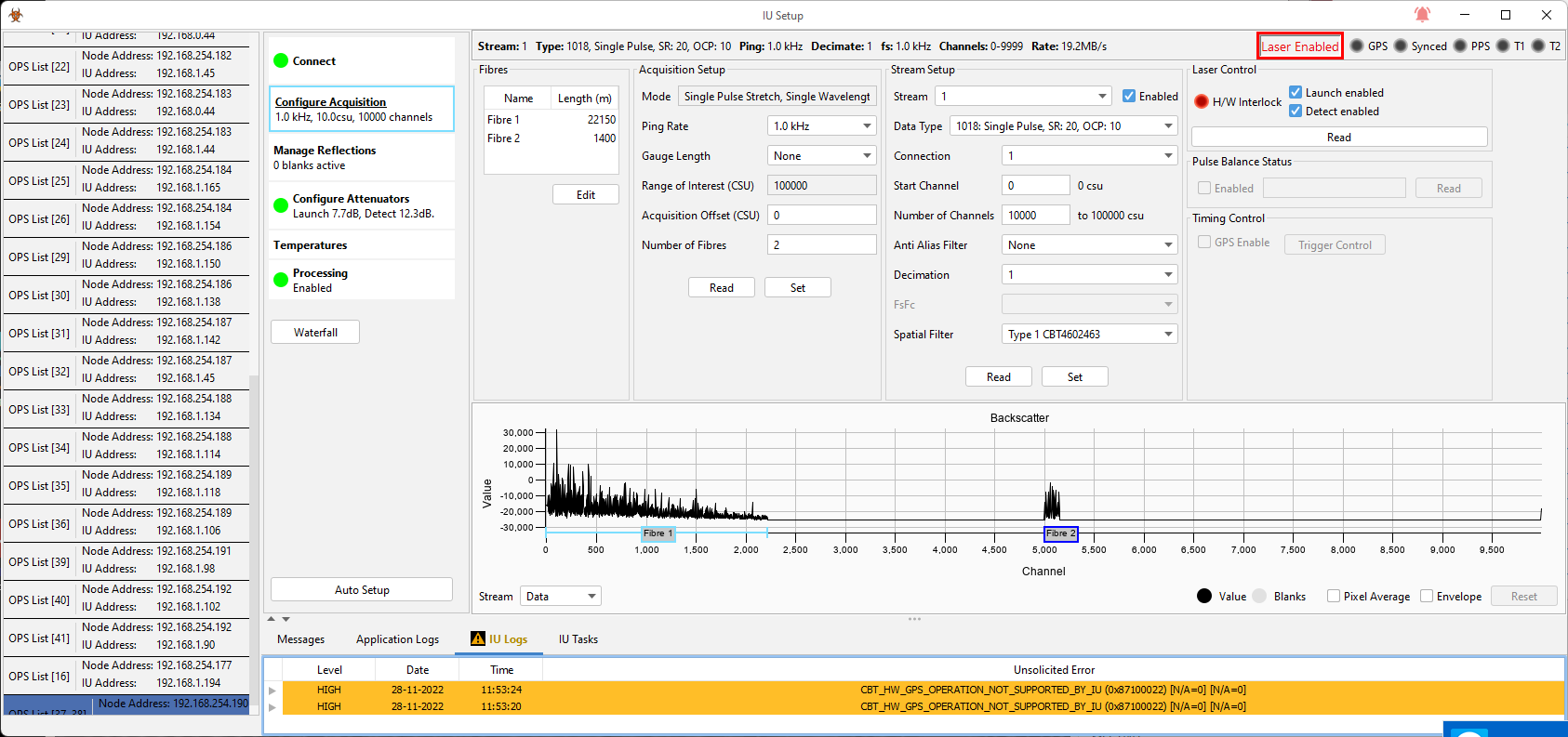
Additional Setup Functions
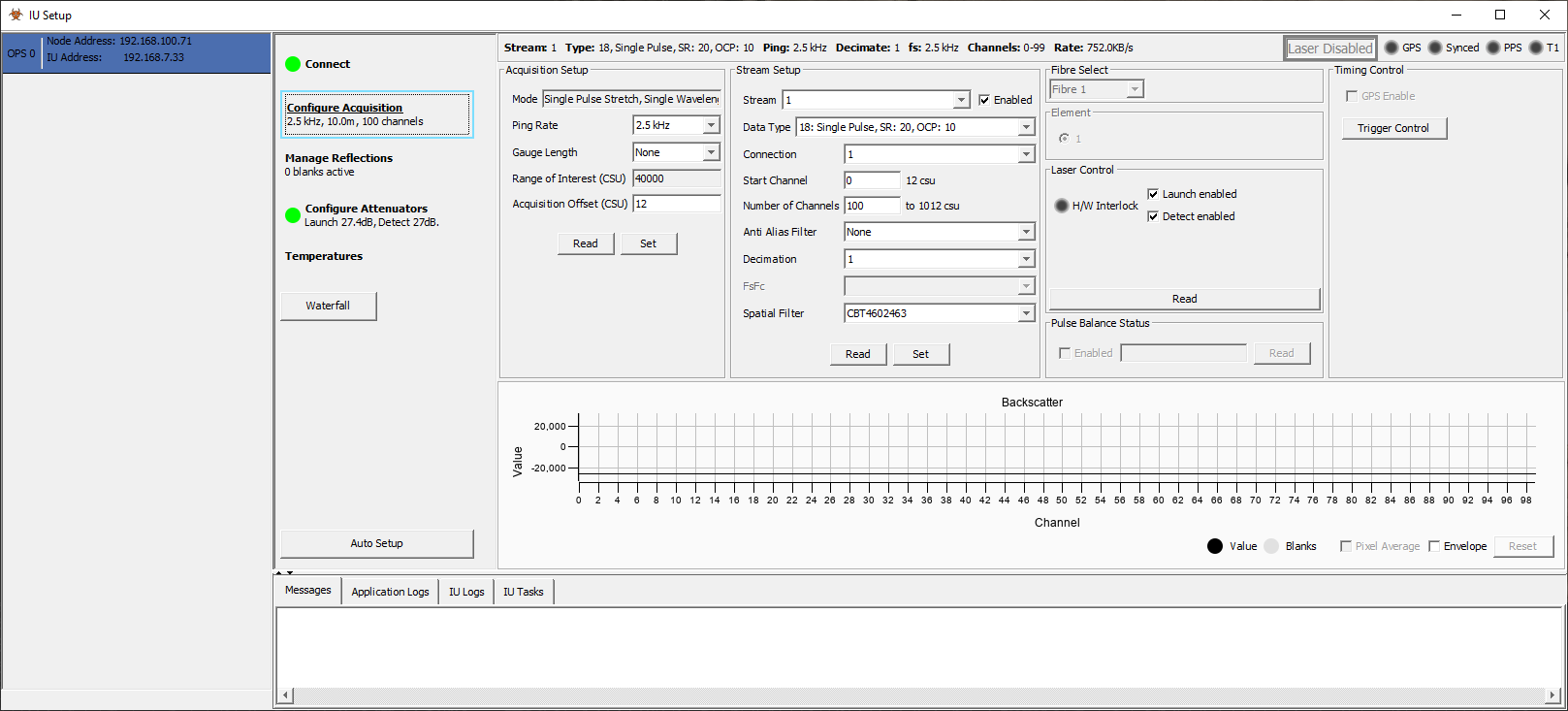
Options for fibre length, sample rate and spatial resolution
If a sensing fibre that is connected is LONGER than the stated fibre length (i.e. crossover approach), the settings will need to be saved as they are not maintained on reboot of the IU.
In normal circumstances there is only a single fibre length to consider – the physical length of the fibre is equal to the sensing length. This, together with the channel size defines how many channels the system will operate with.
Additionally, the sample rate reduces with increasing fibre length. This is a matter of simple physics; a new laser pulse must not be sent down the fibre until the scatter from the end of the fibre has reached the detector.
In the circumstances where we are operating with a fibre length longer than the sensing length, the following rules should be noted:
- Fibre Length should be set to the sensing length
- Sampling Size should be set commensurate with the sensing length
- Sampling Rate should be set commensurate with the full physical fibre length
Interrogation (Ping) Rate
The maximum interrogation (ping) rate is determined by the length of the connected fibre. Best performance is obtained using the maximum rate possible for the fibre, with subsequent time-domain decimation if the band of interest is less than Ping Rate / 2. Not all ping rates are available across all IUs
The maximum interrogation Rate (kHz) for a fibre of length L (km) is determined by:
IRmax (kHz) = 100 / L (km)
For best performance, use the nearest Ping Rate from the drop down that is smaller than the calculated maximum from knowledge of the connected fibre length.
The table below provides a look up for cable lengths against ping rates and the corresponding acoustic bandwidth.
| Interrogation Rate | Nominal Acoustic Bandwidth | Max cable Length |
|---|---|---|
| 0.5 kHz | 250 Hz | 160 km |
| 0.8 kHz | 400 Hz | 100 km |
| 1 kHz | 500 Hz | 80 km |
| 2 kHz | 1 kHz | 40 km |
| 2.5 kHz | 1.25 kHz | 40 km |
| 3.125 kHz | 1.56 kHz | 32 km |
| 4 kHz | 2 kHz | 25 km |
| 5 kHz | 2.5 kHz | 20 km |
| 8 kHz | 4 kHz | 12.5 km |
| 10 kHz | 5 kHz | 10 km |
Note that the Maximum Cable Length is that to which the IU may be connected – it does not imply data will be available out to this range.
If the selected and calculated rates are very close, inspect the backscatter closely at the beginning and end of the waterfall as different fibres will have slight differences in propagation velocity which may cause overlap. If the IU is pinging too fast for the fibre length, the backscatter signal from the end of the fibre will be superimposed on the start of the next interrogation cycle, producing interference/noise on the front end of the trace.
Stream Setup – Decimation
Luna IUs can output decimated data streams for certain data types. If a selected decimation factor is not supported for the combination of IU & Data types then it will be rejected. Software provided decimation can also be applied from the ‘Processing’ Tab (see Temporal Decimation).
Verifying the settings
The Auto Setup option can be used to attenuate lasers as well as establishing the fibre length although the fibre length should always be confirmed using an OTDR. The setup process may take a couple of minutes and the status can be seen in the Status output. However, the results from the Auto Setup feature should be verified manually. See the manual steps below.
During the Auto Setup procedure, the IU first increases the detect attenuator to its maximum value, it then changes the launch attenuator value and sweeps through all of the launch values until it detects clipping. It then monitors for clipping over a 30 second period to ensure that no clipping occurs.
After the process is completed, it is recommended checks the configuration using the techniques detailed in Manual Attenuation of an IU.
Managing Reflections and Fibre Breaks
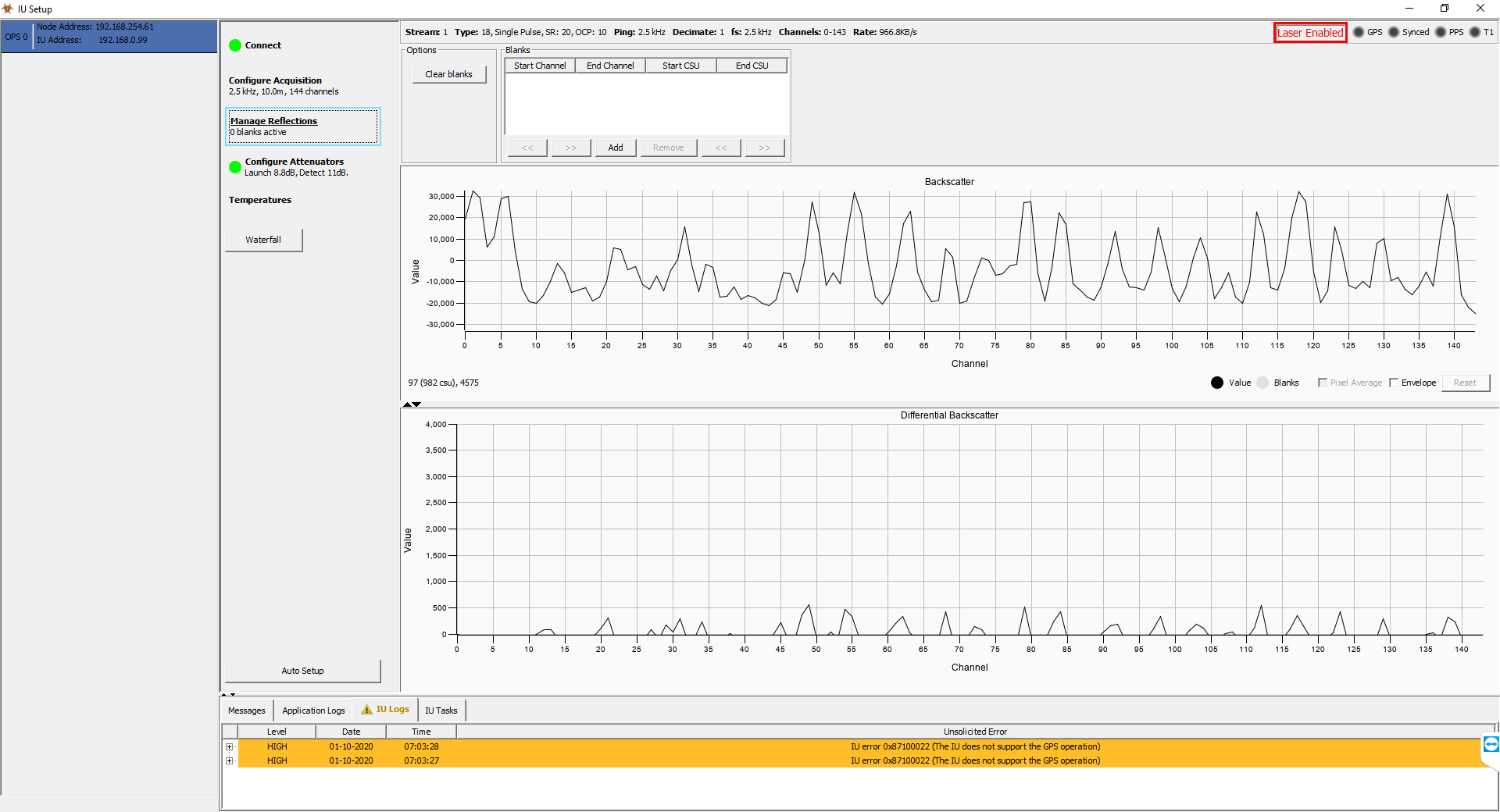
An advanced feature of the IU Setup is the Manage Reflections section. This allows the user to blank out a number of channels where there is a reflection from an event down the fibre, such as a bad splice, micro bends, fibre breaks or the end of the fibre.
It is recommended that the advanced manage reflections is only used if the fibre cannot be repaired or the fault removed.
Navigate to the IU Setup and select the Manage Reflections tab. In the Blanks box press the Add button to create a new blank. This is the start process to adding your start and end channel values.
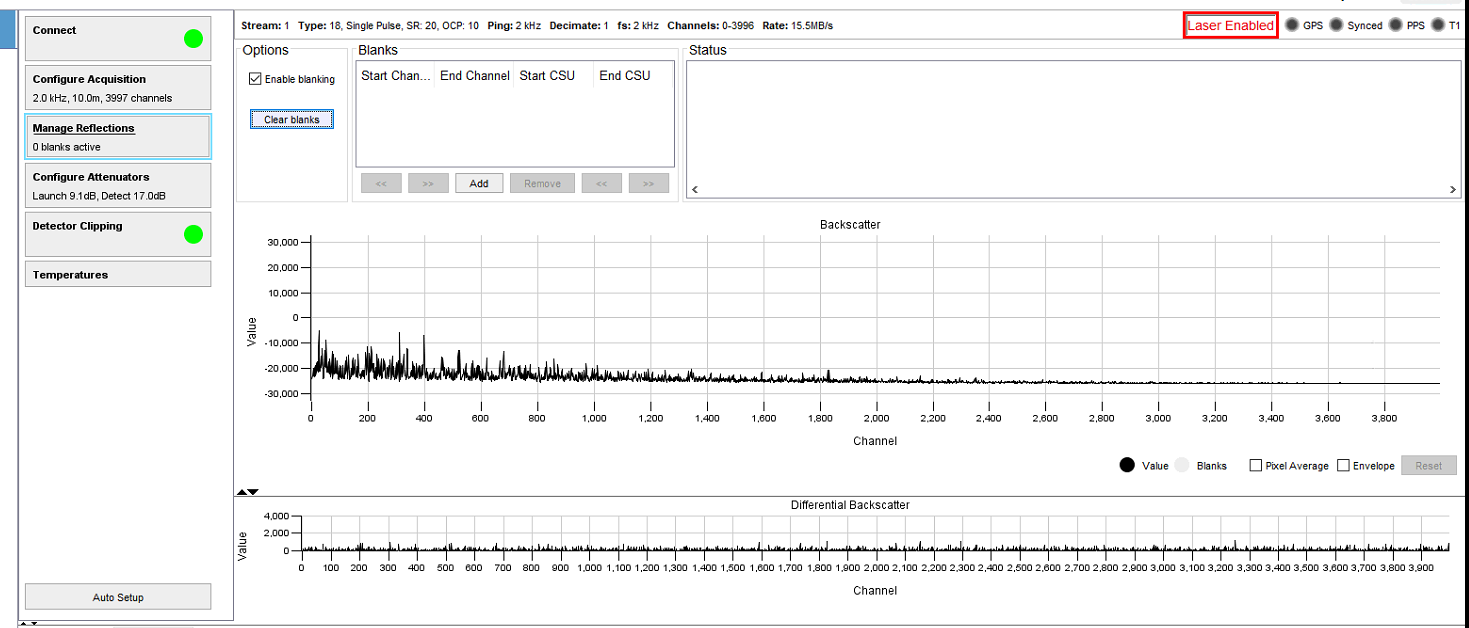
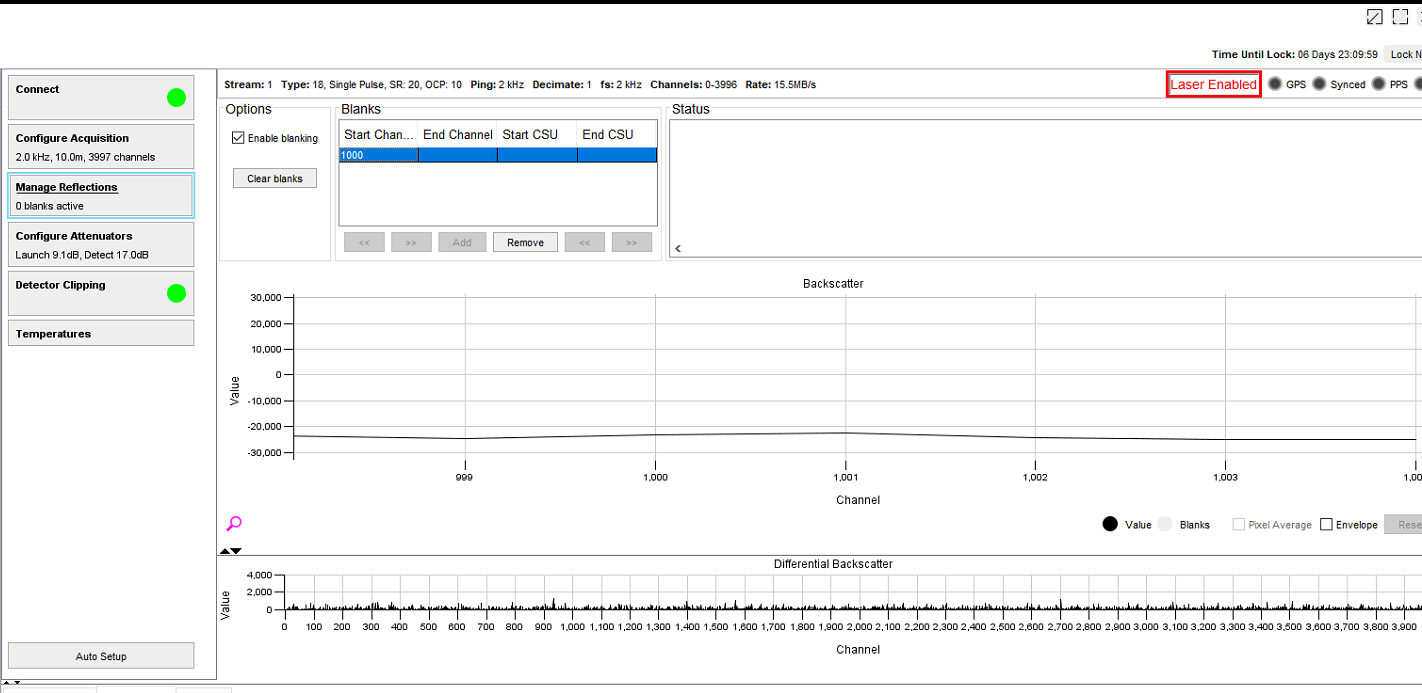
To identify the start and end channels, adjust zoom to the start of the reflection event within the backscatter panel. In the example below the start channel is 1000. Enter this value into the start channel cell in the blanks table then press enter.
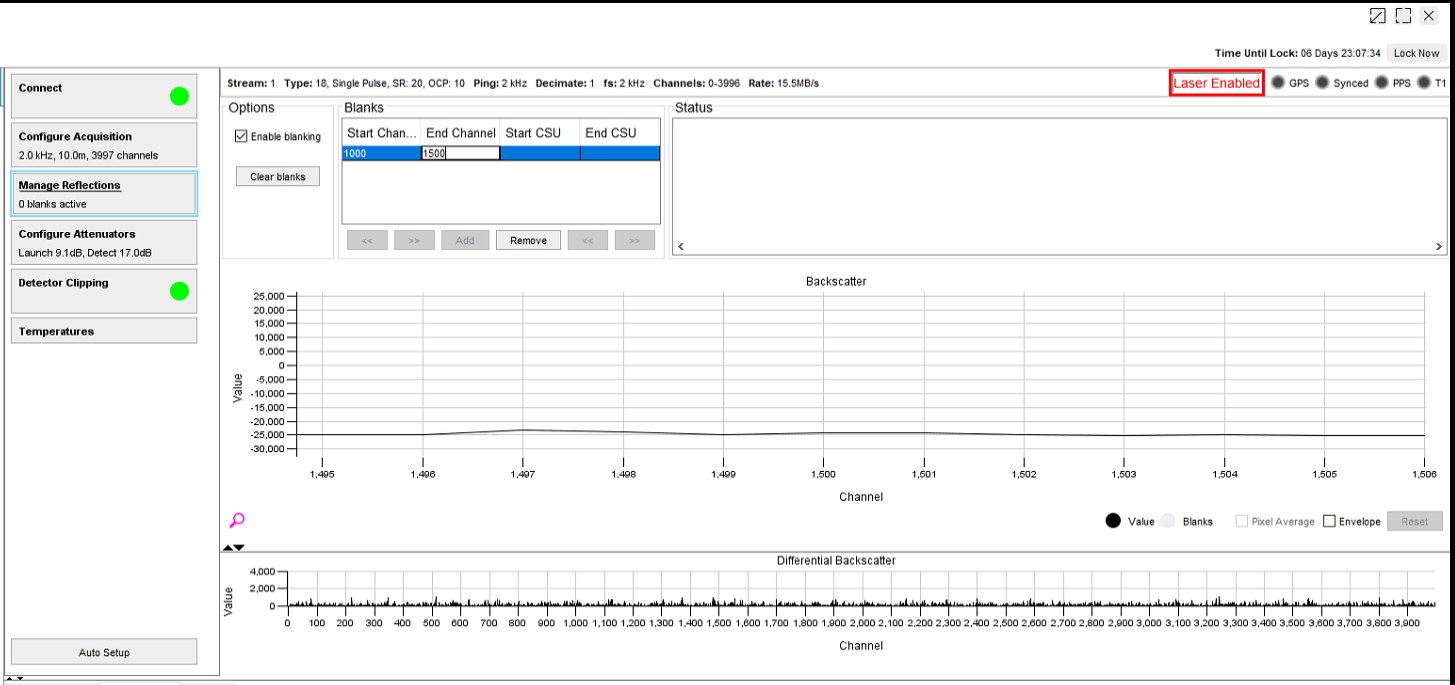
For the end channel, locate the channel in the backscatter panel as before and enter this value into the end channel cell in the blanks table. The blank that is being applied will normally only be a few channels but to assist with the visual representation the blanks applied here are much larger.
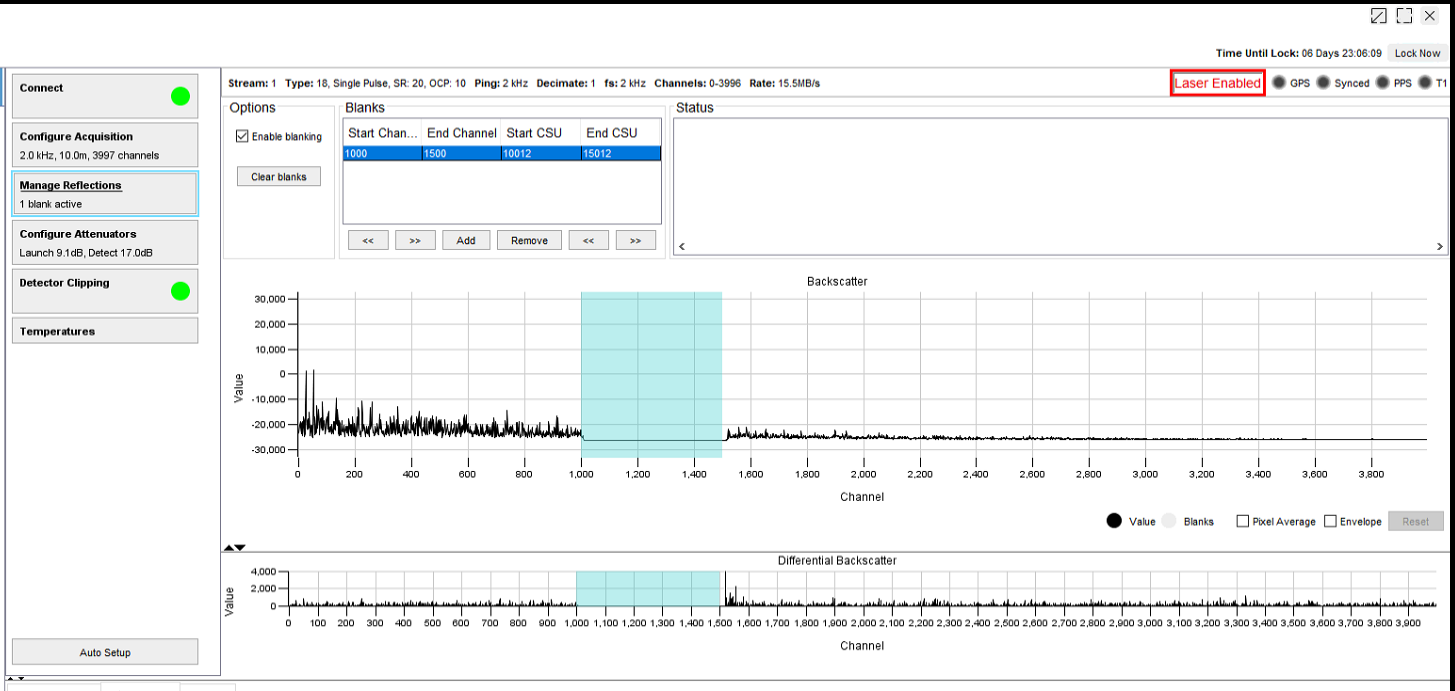
As shown in the figure below, the blanking zone has been created and the backscatter within this region is greatly reduced. The added blanking zone is shaded on the backscatter panel to provide visual indication of the region it covers.
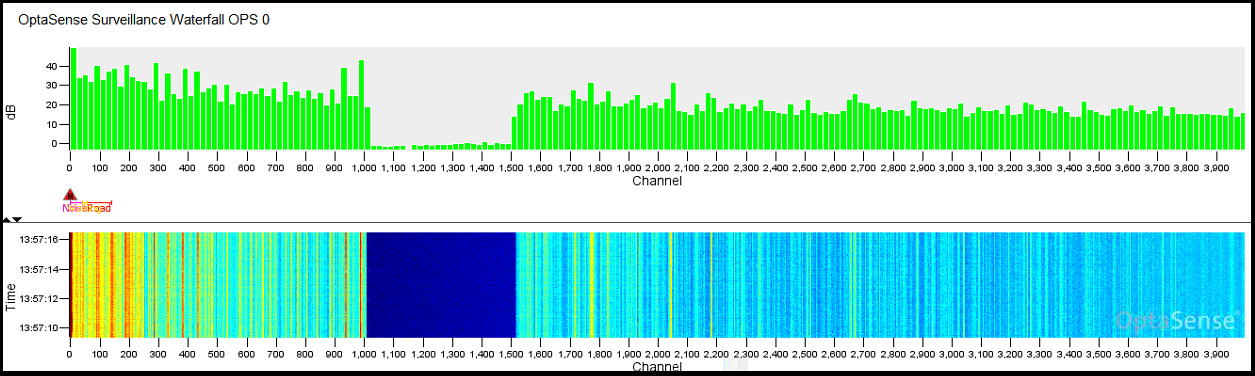
If you navigate to the surveillance waterfall window you will see further evidence that the blanking zone has been created.
Multiple reflection blanking zones can be created if need be.
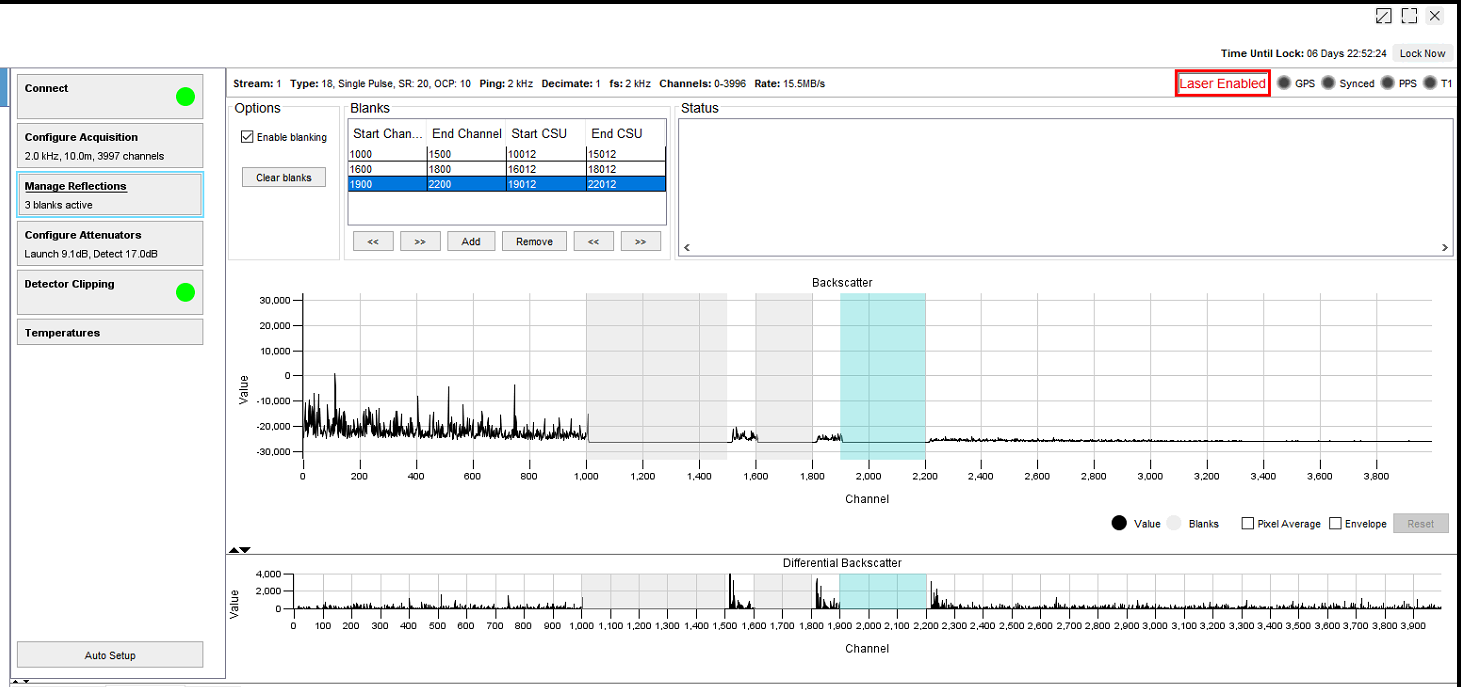
If there is a requirement to change the channel span, select the blank to be changed in the Blanks table. The currently selected blank will be highlighted in blue. The shaded region on the backscatter will also be highlighted in light blue. Double clicking the Start or End cells allows these values to be adjusted as necessary.
To remove a blank, select the blank to be removed in the Blanks table and press the Remove button. It is also possible to clear all blanks by pressing the Clear blanks button.
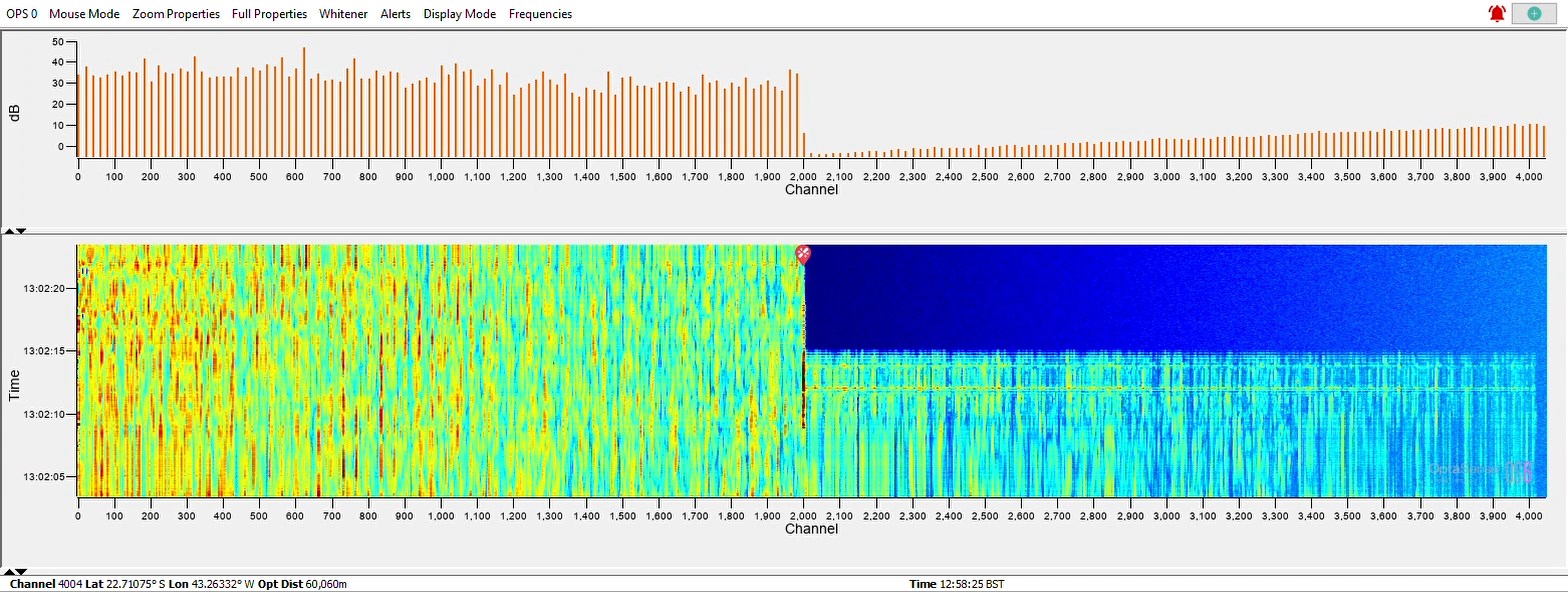
Identifying a Fibre Break
When a fibre is broken it will be noticeable on the Surveillance Waterfall. The display will show a complete absence of signal from the point of the break to the end of the fibre. This will be followed by a Fibre Break alert appearing on the system. The immediate action on a fibre break is to check the extent of the reflection caused in the IU Setup panel. Any reflection of concern will be at the point of the break and will be shown as a large spike above the usual backscatter signal.
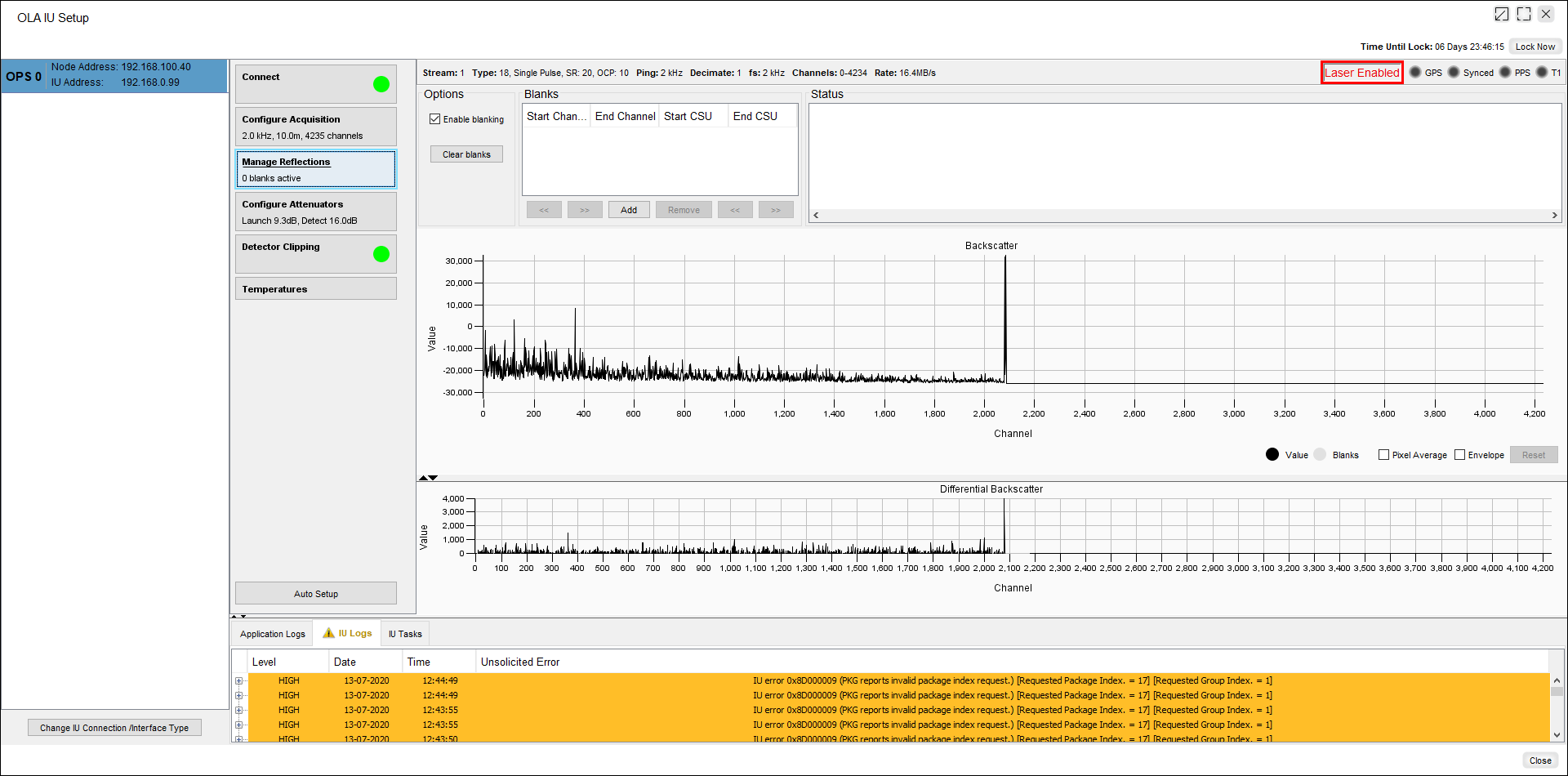
IU Setup requires super-user access
The system will continue to operate as normal up to the fibre break but follow-on action must be taken to protect the IU from potential damage caused by reflected light.
Once a reflection has been identified then a blank can be added to protect the IU from reflection thus allowing the IU to be left operational until the fibre is repaired.
IUs must not be left running with a broken (or unterminated) fibre indefinitely.
Additional IU information
ODH-F
ODH-F builds on prior Luna Interrogator Unit developments and is intended to be able to flexibly deliver short-range (<15 km) quantitative data or long range qualitative data with similar performance levels to our OLA 2.1 although is NOT intended to replicate it.
There are 4 variants of the ODH-F, an intensity only variant, a multiplexing intensity only variant that allows the acoustic intensity of up to 4 cables to be monitored , a quantitative variant capable of doing everything the base model is capable but also of acquiring quantitative data and a multiplexing quantitative variant that allows the interrogation of 4 cables and acquisition of quantitative data.
Many of the configuration practices are similar or the same as for the previously mentioned IU’s. The configuration procedure to use is dependent on how the IU is being used (amplitude only or quantitative mode, with or without multiplexing). This guide discusses the configuration required for all these operation modes, dependent on the unit not all these modes may be accessible. Connection to the IU and data types are also discussed.
OS6 does currently support Multiplexing in ODH-F.
Data types
A range of non-quantitative and quantitative data types are available in the ODH-F:
| Type | Description | Type |
|---|---|---|
| 1001 | Single Pulse SR 1.5 OCP 1 | Non-quantitative |
| 1002 | Scope Data | Quantitative |
| 1003 | Launch Pulse Diagnostic Data | Non-quantitative |
| 1004 | Diversity Stacked OCP 8 | Quantitative |
| 1005 | Diversity Stacked Metadata OCP 8 | Quantitative |
| 1009 | Phase OCP 1 | Quantitative |
| 1012 | Dual Pulse ADC OCP1 | Quantitative |
| 1013 | Diversity Stacked DC OCP 8 | Quantitative |
| 1014 | Diversity Stacked Metadata DC OCP 8 | Quantitative |
| 1015 | Single Pulse SR 1.5 OCP 8 | Non-quantitative |
| 1018 | Single Pulse SR 20 OCP 10 | Non-quantitative |
| 1019 | Single Pulse SR 7.25 OCP 5 | Non-quantitative |
| 1024 | Phase OCP 1 0.001xfs cutoff | Quantitative |
| 1061 | Scope Data Max | Non-quantitative |
| 1062 | Single Pulse SR 1.5 OCP 1 HdB | Non-quantitative |
| 1063 | Single Pulse SR 1.5 OCP 8 HdB | Non-quantitative |
| 1064 | Single Pulse SR 20 OCP 10 HdB | Non-quantitative |
| 1065 | Single Pulse SR 7.25 OCP 5 HdB | Non-quantitative |
OCP= Output Pitch (m), SR= Spatial resolution (m).
The best data type to use is dependent on the application. Quantitative data can only be collected from shorter length cables (<15km), so this limits the applications that can have quantitative data collected. As such for applications requiring the monitoring of longer assets, non-quantitative data must be collected. Quantitative data has the advantage that it collects phase information about the acoustic waves interacting with the cable, allowing more detailed analysis and information extraction from the data.
In terms of the non-quantitative data types the significant difference between each type is the OCP and SR lengths of the data type. The optimum spatial resolution is a function of the required sensitivity (the larger the gauge the lower the signal to noise ratio) and the frequency content of signals to be detected (the higher the frequency needing to be monitored the shorter the gauge length should be, due to spatial averaging). Data type 1018 is an equivalent to the 20m gauge of the OLA 2.1.
The main quantitative data types are DT1004 and DT1013. Data type 1004 is diversity stacked quantitative data with a high pass filter to remove low frequency signals. Data type 1013 is equivalent to DT1004 with the high pass filter removed in the signal processing chain. Both of these have an OCP of 8 m. In most situations the low frequency content is informative and data type 1013 should be recorded. DT1009 provides quantitative phase data with no diversity stacking and an OCP of 1m. This datatype is oversampled spatially. A heavily decimated version of DT1009 is available as DT1024, which can be used for recording very low frequency measurements.
Data type 1002 is the scope mode for the dual pulse configuration that gives the optical amplitude for reflected light and is used to setup the launch and receive attenuators for collection of quantitative data.
Multiplexing
In an ODH-F with multiplexing capability up to 4 fibres can be monitored. OS6 does not currently support multiplexing.
QuantX
The QuantX system has been developed specifically to address sensing applications which require high quality quantitative phase and amplitude output and the practical levels of asset coverage that were previously only available with a qualitative IUs solution.
It is important to note that prior to any operation of the QuantX, the transport bolts must be removed. Detailed information on this can be found in the IU User Manual.
IU Connection
The QuantX IU requires two connections: an RJ45 control connection and a High data-rate Mellanox connection.
The control connection must be passed through a network switch in order to negotiate between the IU and a computer.
Data types
The following data types are available for QuantX. Note where the data types refer to single or dual pulse, this should NOT be confused with being Quantitative and Non Quantitative modes, rather the pulses here are referred to the number of information carriers.
| Drop Down Option | Data Type | Description |
|---|---|---|
| ADC Data | 1074 1075 | ADC Data (single carrier) - Raw ADC Data for Engineering Use (not used) ADC Data (dual carrier) - Raw ADC Data for Engineering Use (not used) |
| Scope Data | 1076 1077 | X Y Scope Data (single carrier) – Used for Optical Optimisation X Y Scope Data (dual carrier) – Used for Optical Optimisation |
| Phase Data | 1078 1079 1080 1081 | Diversity Processed Phase (single carrier) – 1m OCP (10 CSU) Diversity Processed Phase (dual carrier) – 1m OCP (10 CSU) Diversity Processed Phase (single carrier) – 10m OCP (100 CSU) Diversity Processed Phase (dual carrier) – 10m OCP (100 CSU) |
Choice of Mode of Operation (single or dual carrier)
The fundamental mode of operation is to launch a pulse of light into the optical fibre. The Rayleigh Backscatter returned to the IU is then analysed, allowing the time-varying phase signal from along the fibre to be determined.
The IU can operate in either “Single Carrier” (data types 1078 and 1080) or “Dual Carrier” mode (data types 1079 and 1081). In dual carrier mode, the IU uses two independent pulses to interrogate the fibre. This provides two overlaid, semi-independent backscatter patterns, each providing an independent measure of the phase data which can then be combined to reduce the effects of fading. While reducing fading, this can be detrimental to the data quality through the introduction of inter-carrier crosstalk (particularly where large signals are present) and a small general increase to the noise levels. Nonetheless, for many applications the benefits are likely to outweigh the drawbacks.
The optimum mode will depend on the specific situation and signals of interest:
Single Carrier Mode is best where:
-
Large, high frequency, signals are present
-
Spatial discrimination is important
-
The fibre has low losses
-
The loss / range profile sits well within the Performance Envelope
Dual Carrier Mode is best where:
-
Performance at long range is important
-
Losses are challenging
-
Longer gauge lengths are being used
ATLAS
The ATLAS IU builds on the QuantX IU by significantly reducing the weight and formfactor while providing the same high-quality, long range quantitative sensing, adding simultaneous muilti-fibre sensing and simplying the IU connectivity.
Data types
The following data types are available for QuantX. Note where the data types refer to single or dual pulse, this should NOT be confused with being Quantitative and Non Quantitative modes, rather the pulses here are referred to the number of information carriers.
| Drop Down Option | Data Type | Description |
|---|---|---|
| ADC Data | 1074 1075 | ADC Data (single pulse) - Raw ADC Data for Engineering Use (not used) ADC Data (dual pulse) - Raw ADC Data for Engineering Use (not used) |
| Scope Data | 1091 1092 | XY Scope Data (single pulse) – Used for Optical Optimisation XY Scope Data (dual pulse) – Used for Optical Optimisation |
| Phase Data | 1078 1080 1085 1086 1087 1088 1089 1090 1093 1094 | Diversity Processed Phase (single carrier) – 1m OCP (10 CSU) Diversity Processed Phase (single carrier) – 10m OCP (100 CSU) Diversity Processed Phase (dual carrier) – 1m OCP (10 CSU) Diversity Processed Phase (dual carrier) – 10m OCP (100 CSU) Diversity Processed Phase (dual carrier) – 2m OCP (20 CSU) Diversity Processed Phase (dual carrier) – 5m OCP (50 CSU) Diversity Processed Phase (single carrier) – 2m OCP (20 CSU) Diversity Processed Phase (single carrier) – 5m OCP (50 CSU) Diversity Processed Phase (single carrier) – GL/2 OCP Diversity Processed Phase (dual carrier) – GL/2 OCP |
Choice of Mode of Operation (single or dual carrier)
The choice of single or dual carrier operation is the same as with the QuantX. Refer to the information provided here.
Multi-fibre Interrogation
The ATLAS IU is able to simultaneously interrogate more than one fibre. Standard boxes can interrogate two fibres and up to four fibres can be supported by request. In order to achieve this, the maximum sampling rate is 2 kHz, which is split across the number of fibres (i.e. 1 kHz per fibre for dual-fibre or 500 Hz sampling rate for quad-fibre interrogation).
Advanced Activities
Manual Attenuation of an IU
The principle behind manually attenuating an IU is the same across all IUs. Where special instruction relates to a specific IU it will be noted.
For intensity-based IUs (e.g. OLA2.X), the backscatter signal used to attenuate the IU will always be visible. With quantitative units (e.g. ODH-F/QuantX/ATLAS) the datatype either needs to be set to a special scope mode or the backscatter trace switched to view the assurance stream.
Prior to setting the attenuators of the IU (using the Auto Setup function) the Interrogator must be placed into a safe state to avoid damage. To do this, select the Configure Attenuators and set the Launch and Detect attenuators to their maximum values. The number of acquisition channels should be set suffficiently high to ensure that the end of fibre can be seen.
Note that with the QuantX IU, the scope datastream is acquired with approximately 10cm pitch and so the number of acquisition channels for attenuation will be 1 or 2 orders of magnitude greater than for the phase datatypes.
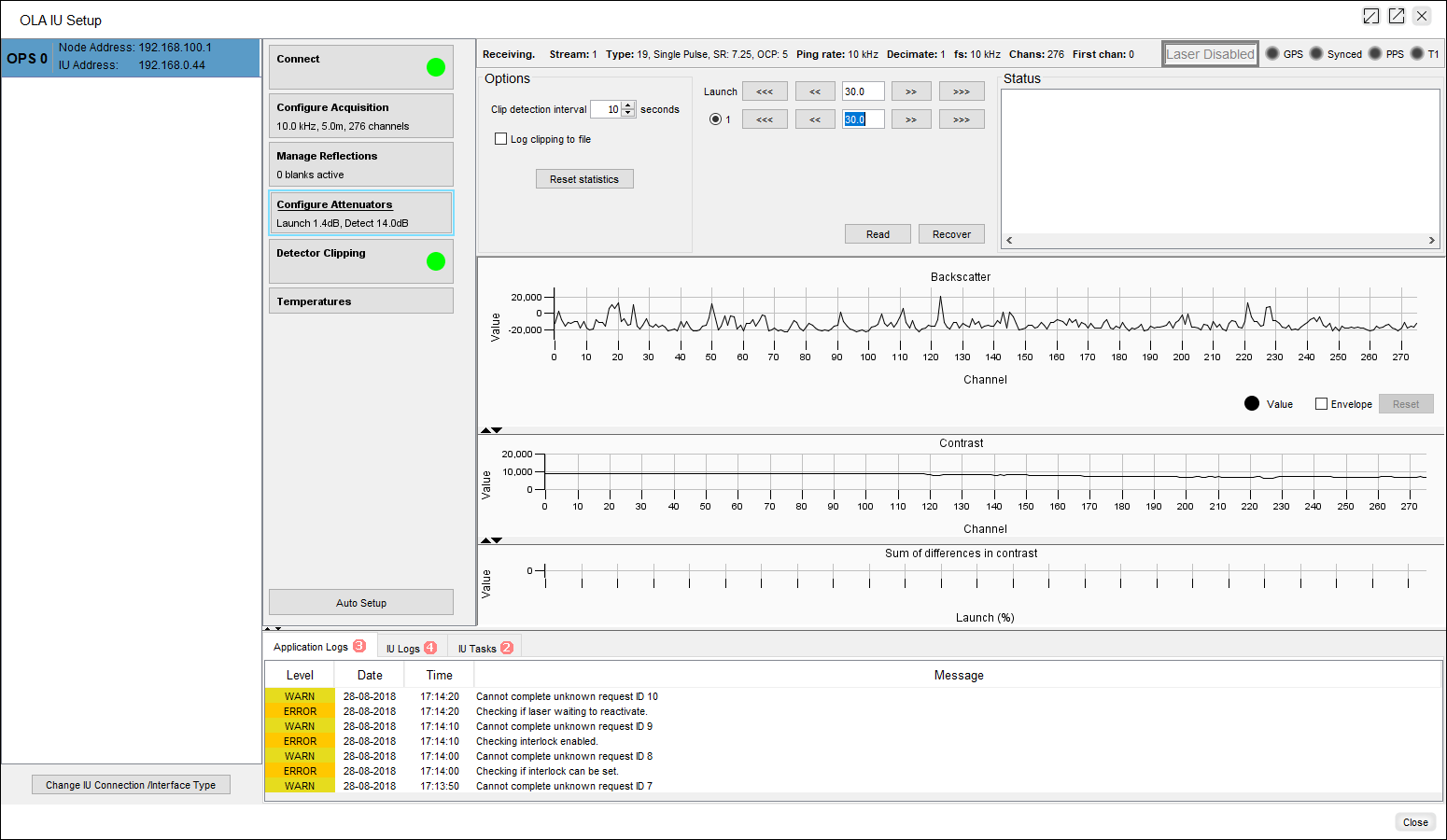
To increase the Launch and Detect attenuators use the ‘>>’ buttons to increase the attenuation. The ‘>>>’ icon will increase attenuation by a greater amount. The ‘<<<’ and ‘<<’ buttons will reduce the amount of attenuation. It is also possible to type a value into the central box as press Enter to enact the change. The actual attenuation value may change slightly from the specified value once the system has made the change.

Once the attenuators have both been set to a safe state and the fibre has been checked with an OTDR to confirm there are no significant reflections present, the laser can be switched on at the IU.
The aim in configuring the attenuators is two-fold:
- To set the launch attenuator to maximise the amount of the light launched into the fibre without causing non-linear behaviour in the fibre. Nonlinear behaviours is only likely to be evident in longer fibres (>10 km)
- To maximise to maximise the amount of light being detected without saturating the detector.
The skill involved is in identifying the point of non-linear behaviour, which we will cover in more detail in detecting the point of non linearity.
Observe the backscatter trace on the Configure Attenuators tab. The trace should appear fairly flat.
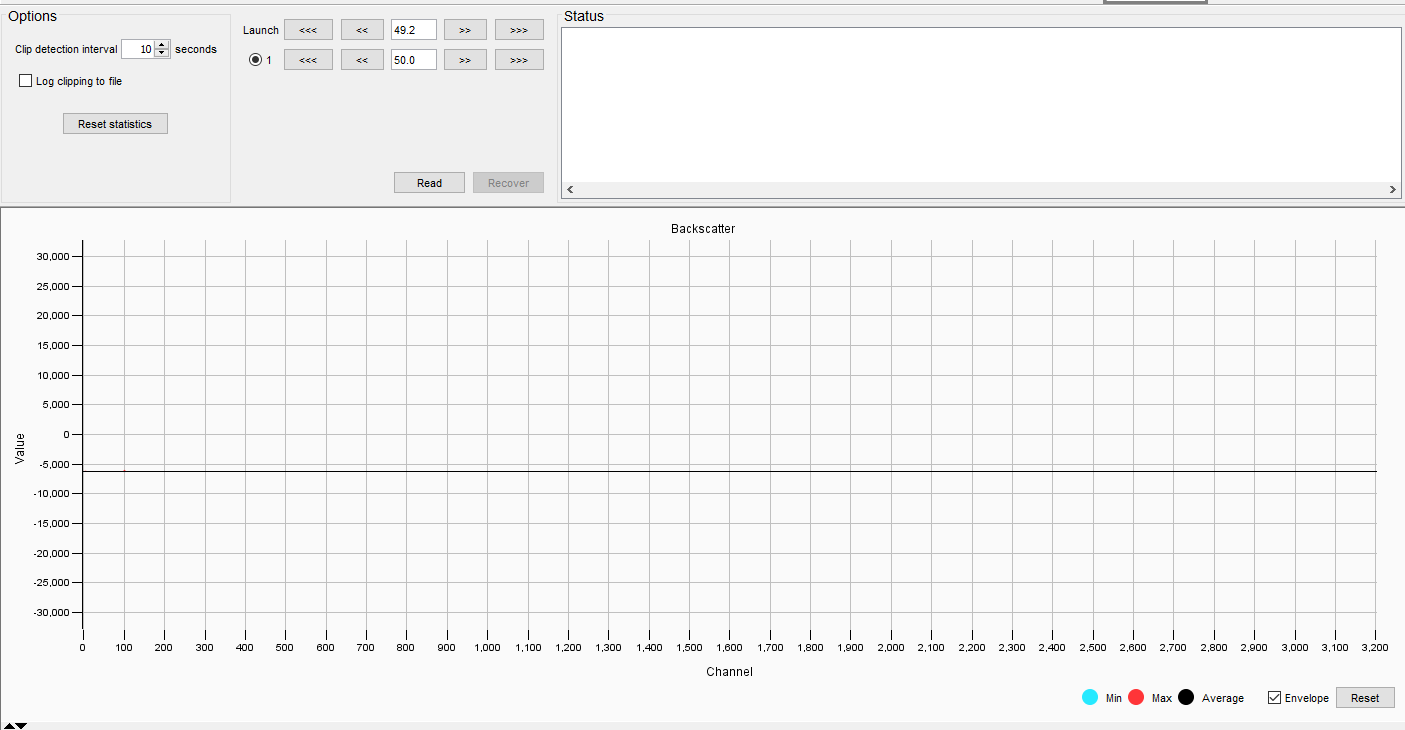
Verifying reflection free conditions
To begin with, gradually allow more light into the system by reducing the launch attenuator. The aim is to see is that no large reflections appear that are much greater than the average signal strength. It may be required to zoom in on the vertical axis in order to see any signal.
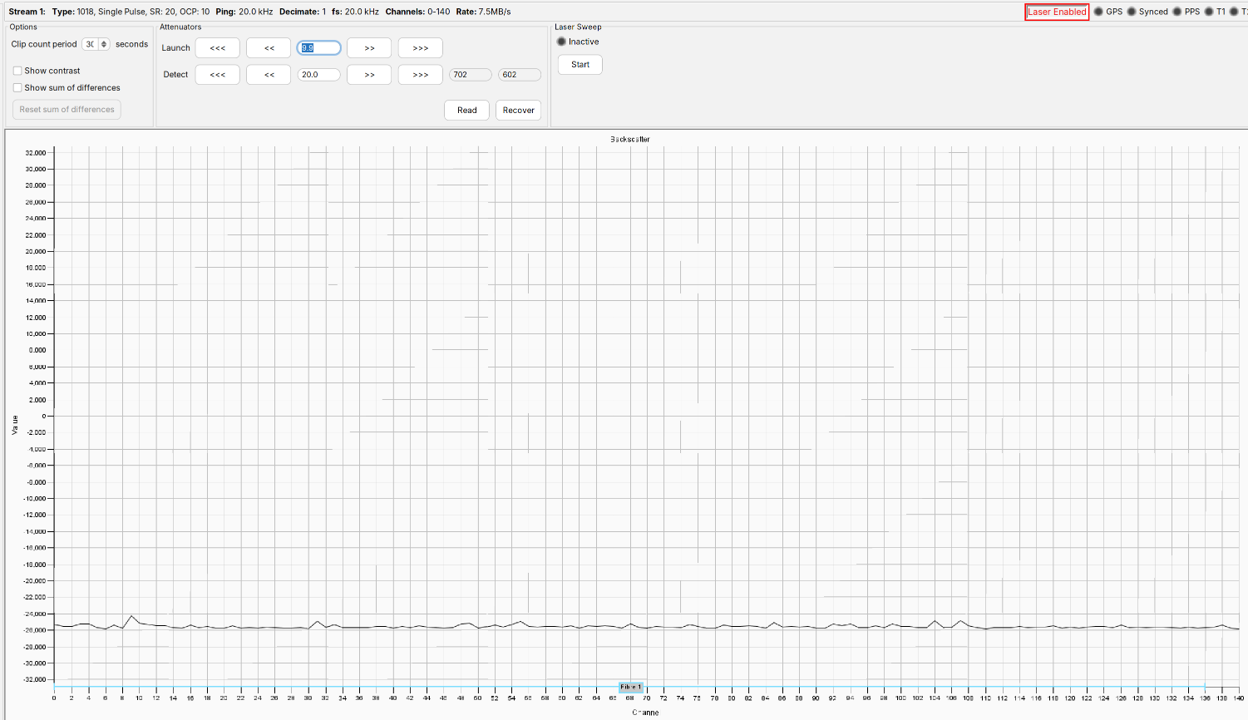
The detect attenuator is less important here - we are more concerned with how much light we are putting into the fibre at this stage.
If you are unsure about some data (whether it is structure or reflection) zoom in or further decrease the launch attenuator – it won’t cause any harm (The detect attenuation can also be reduced to allow greater visibility of the data). What we are looking for are massive signals that may damage the detector if the attenuators are reduced too far. If any massive signal spikes are observed then the fibre should be repaired if possible and blanks implemented if necessary.
Detecting the point of non-linearity
As the launch attenuation is reduced, we are increasing the amount of light that is launched into the fibre. Naturally, the expectation is that the detected backscatter level will also increase. However, once we have reached the point of non-linearity then the detected signal level will actually begin to drop. The launch attenuation setting where non-linearity is observed represents the optimum amount of light that can be launched into the fibre. We can observe the point of non-linearity by looking at the behaviour of the channels towards the end of the fibre. We must do this at the end of the fibre as the non-linearity process is a cumulative process.
The point of non-linearity can be difficult to identify at great distances because there is so little backscatter signal breing detected. It can be simpler to identify the point of non-linearity at a range of about 40 km and this will identify a very similar point.
Zoom in on the last 200 channels. There won’t be much to see at this stage – just a vibrating trace:
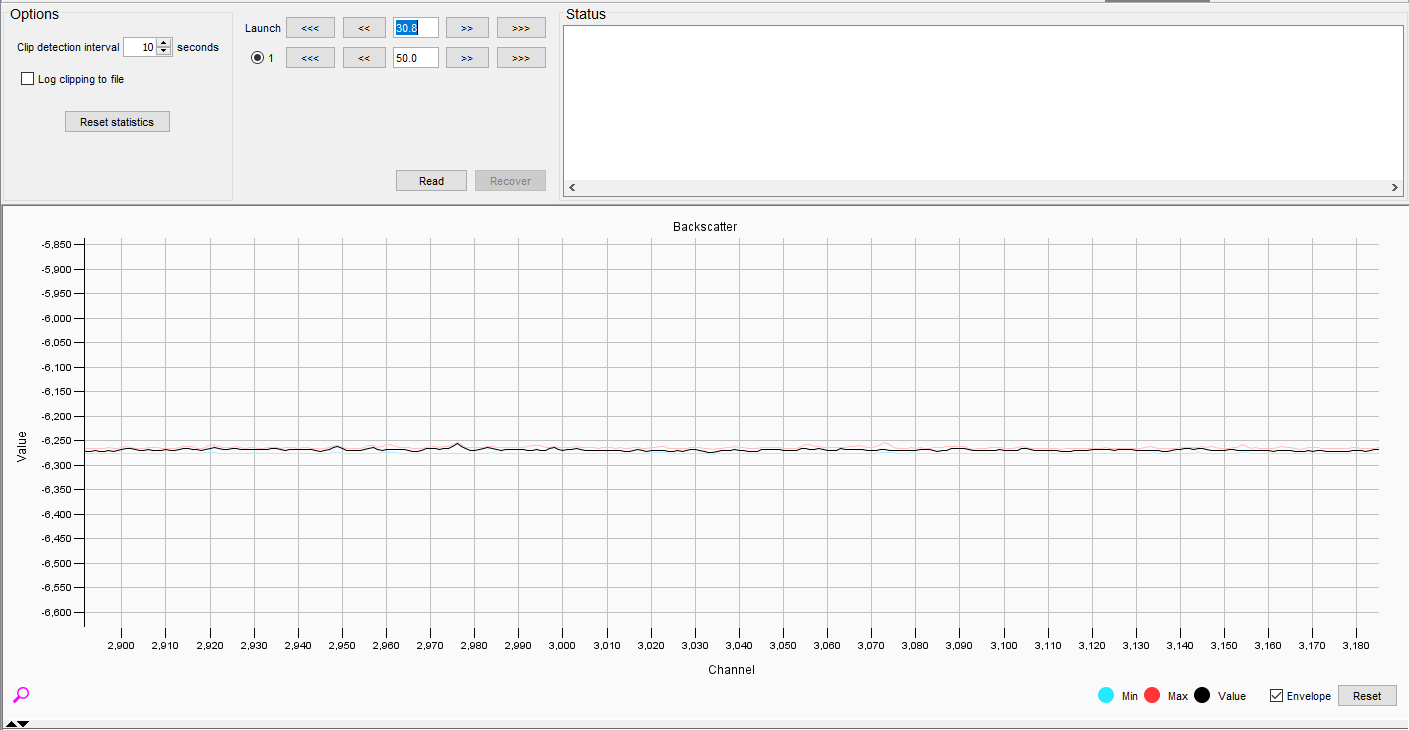
As the launch attenuationis reduced, more signal will appear.
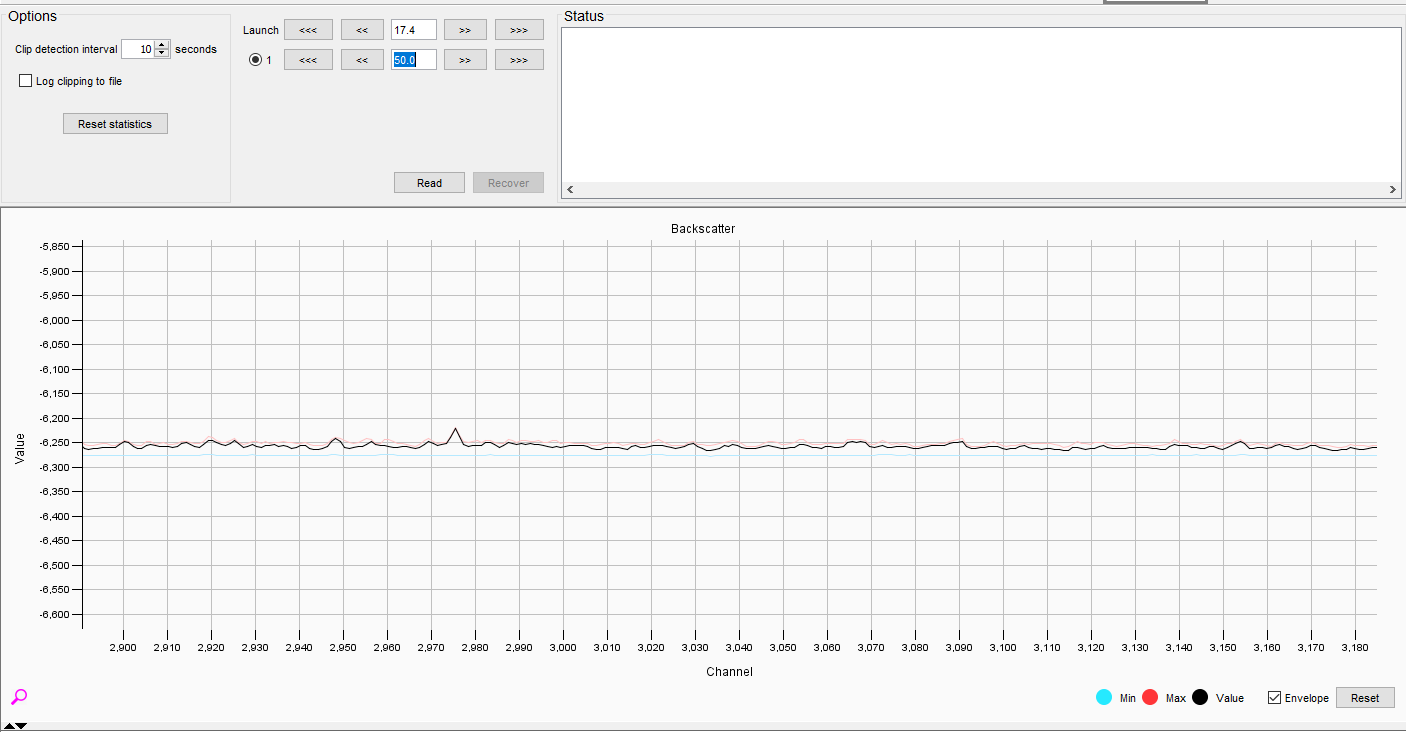
We have a problem though – there is not enough light in the detector to really capture what is going on. Reduce the amount of detect attenuation a bit to allow more light to be captured.
If the detect attenuation is reduced too far as well as the launch attenuation (which is what we will be doing to find locate the point of non-linearity) there is a danger of clipping, particularly at the front of the system. The system can tolerate some clipping but should not be left in such a state for extended periods.
As you are reducing the launch attenuation, keep an eye on the clipping traffic light and occasionally take a look at the whole trace backscatter trace. Keep in mind that as more light is launched into the system we can raise the detect attenuation level in order to prevent clipping and keep the detector safe. Remember, all that we do with the detect attenuation is scale the signal up and down and maximise our use of the dynamic range of the detector – what we are more concerned about at the moment is finding the optimal launch condition.
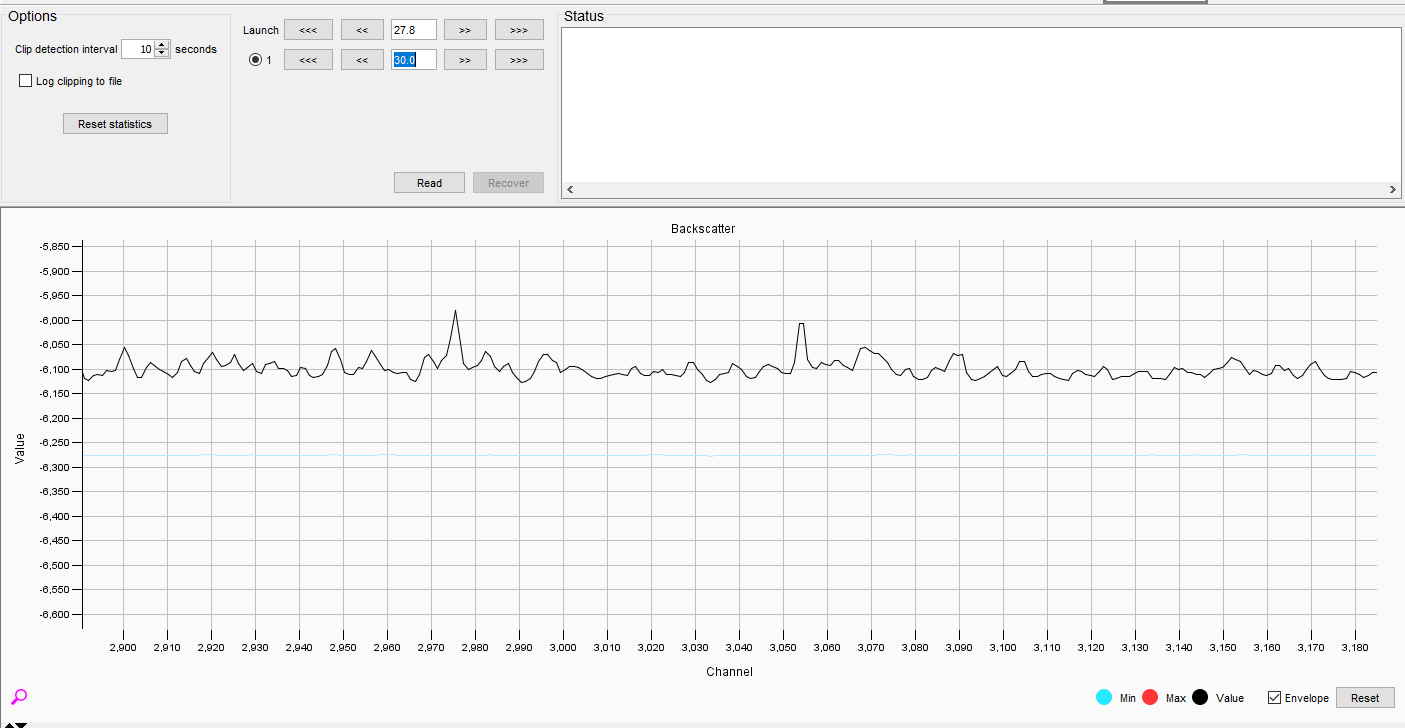
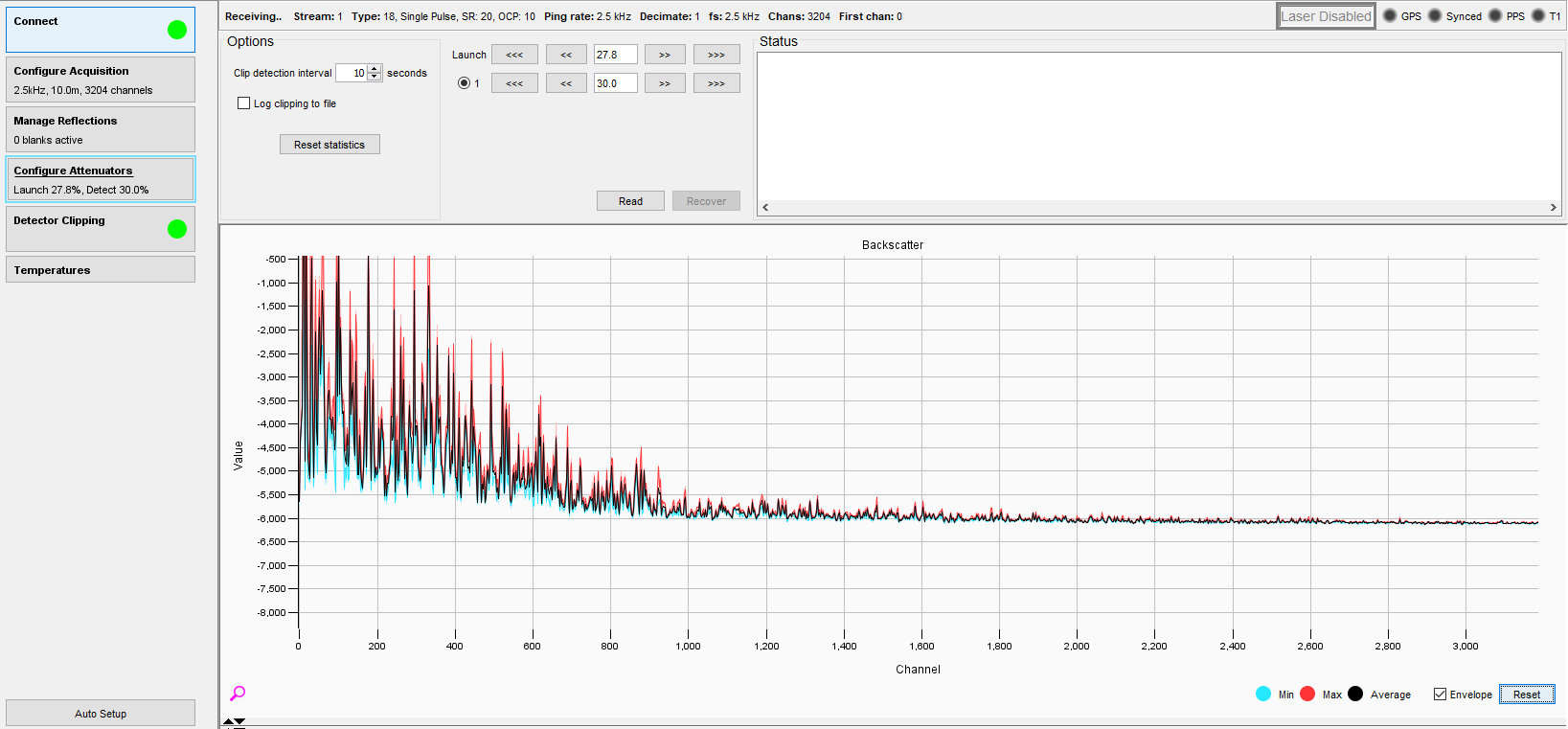
In the series of figures shown below, watch the signal trace rise as the launch attenuation is reduced.
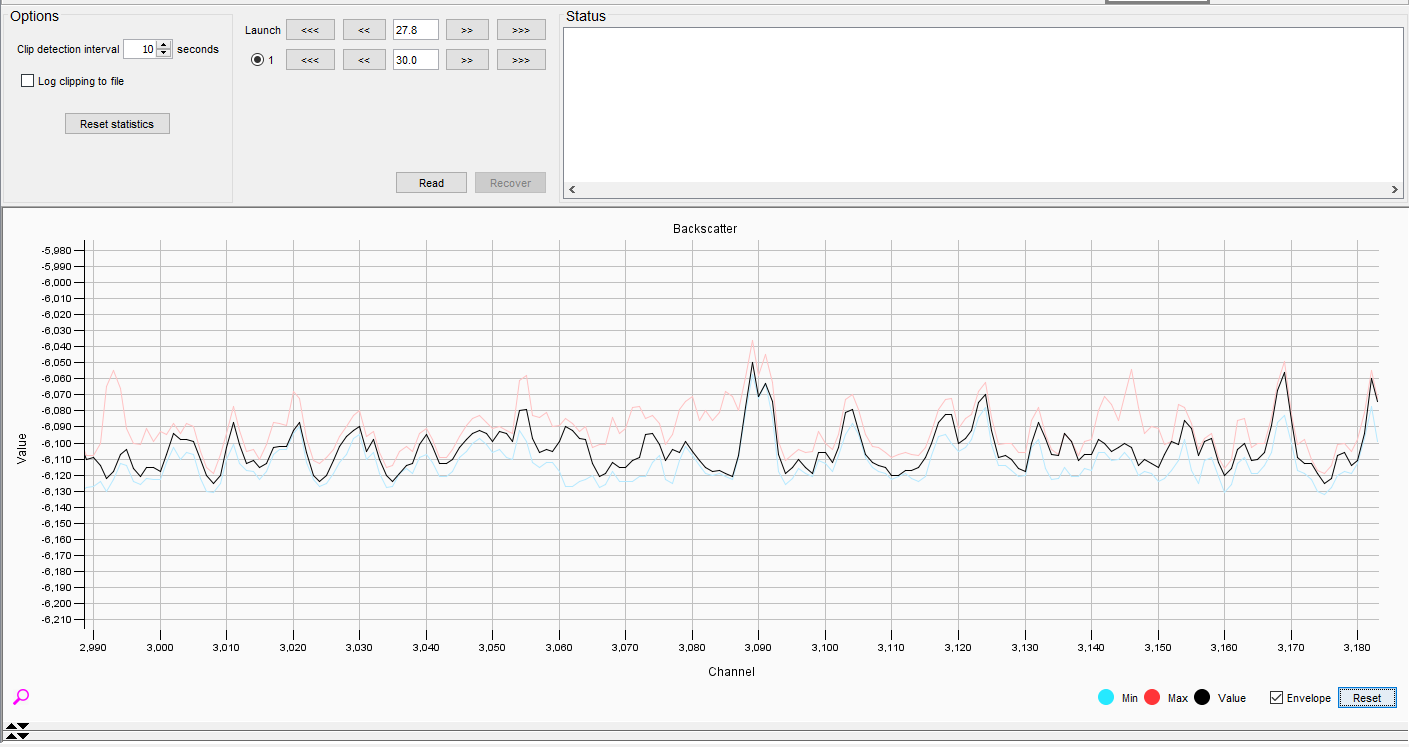
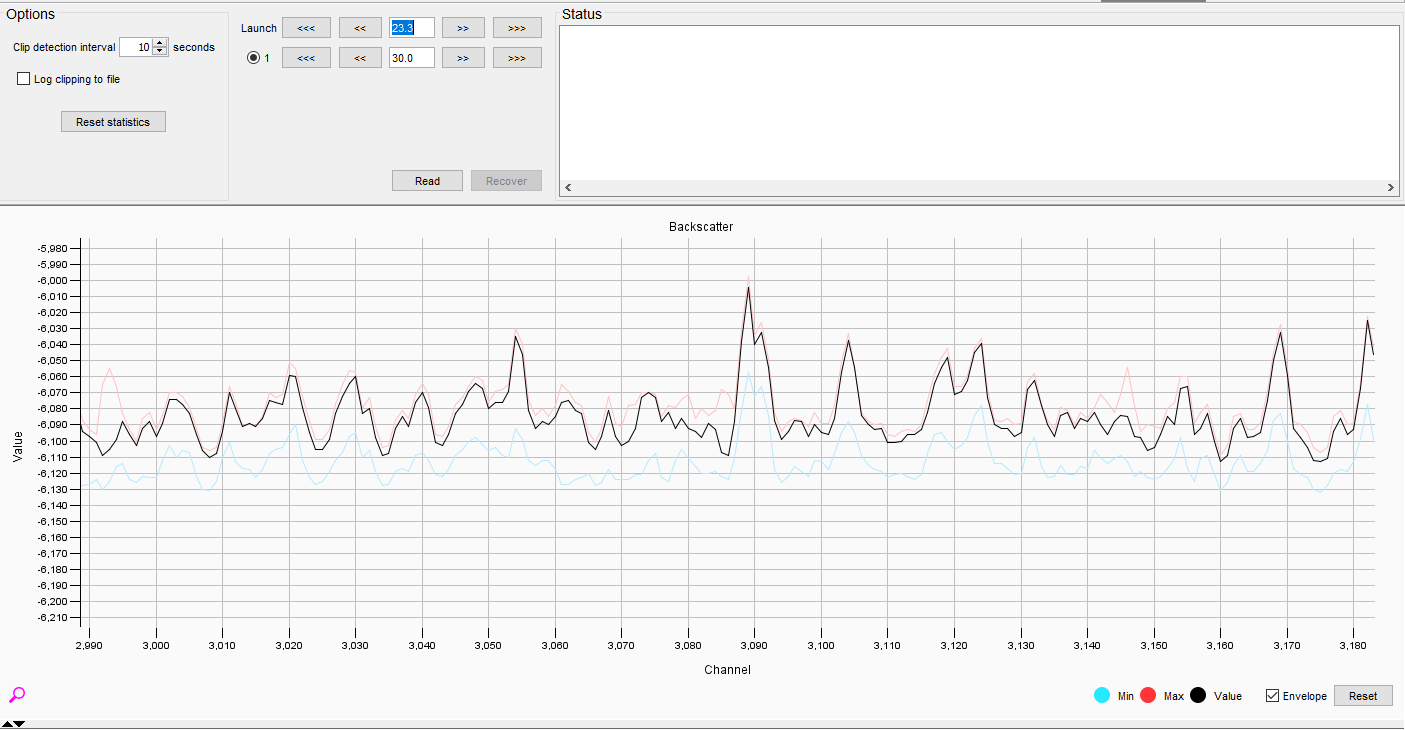
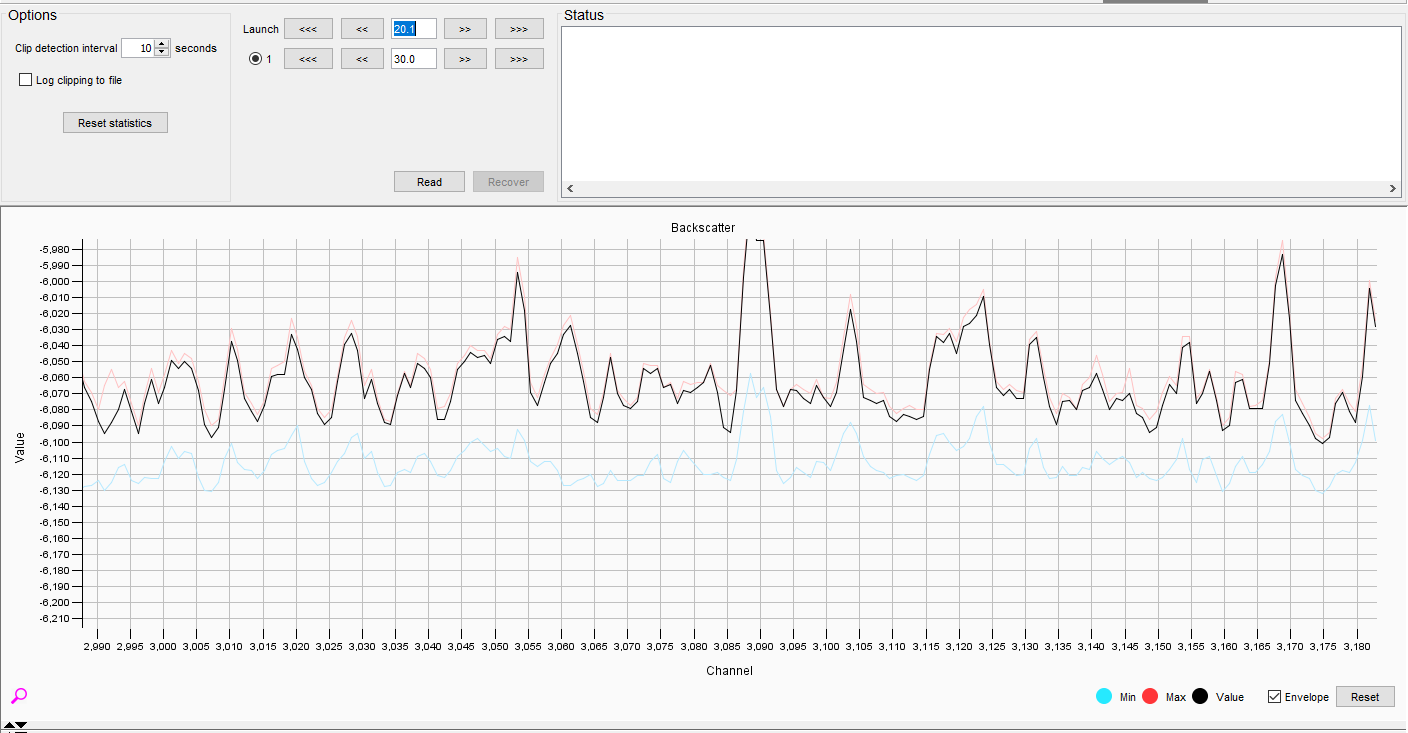
Eventually a point is reached where launching more light into the fibre causes the amount of light at the end to actually drop – this is the key point of interest.
Setting the Launch Attenuator
Having found the optimum launch condition for the fibre, we don’t leave it at this point. Fading affects the gain in the channels and so if we left the launch attenuation at the maximum it would be expected that some channels we are looking at will be faded and when not faded they may enter into non-linearity.
We therefore want to increase the launch attenuation a little to allow for this effect. A recommended increase is to make 5 small step (‘>>’) increases.
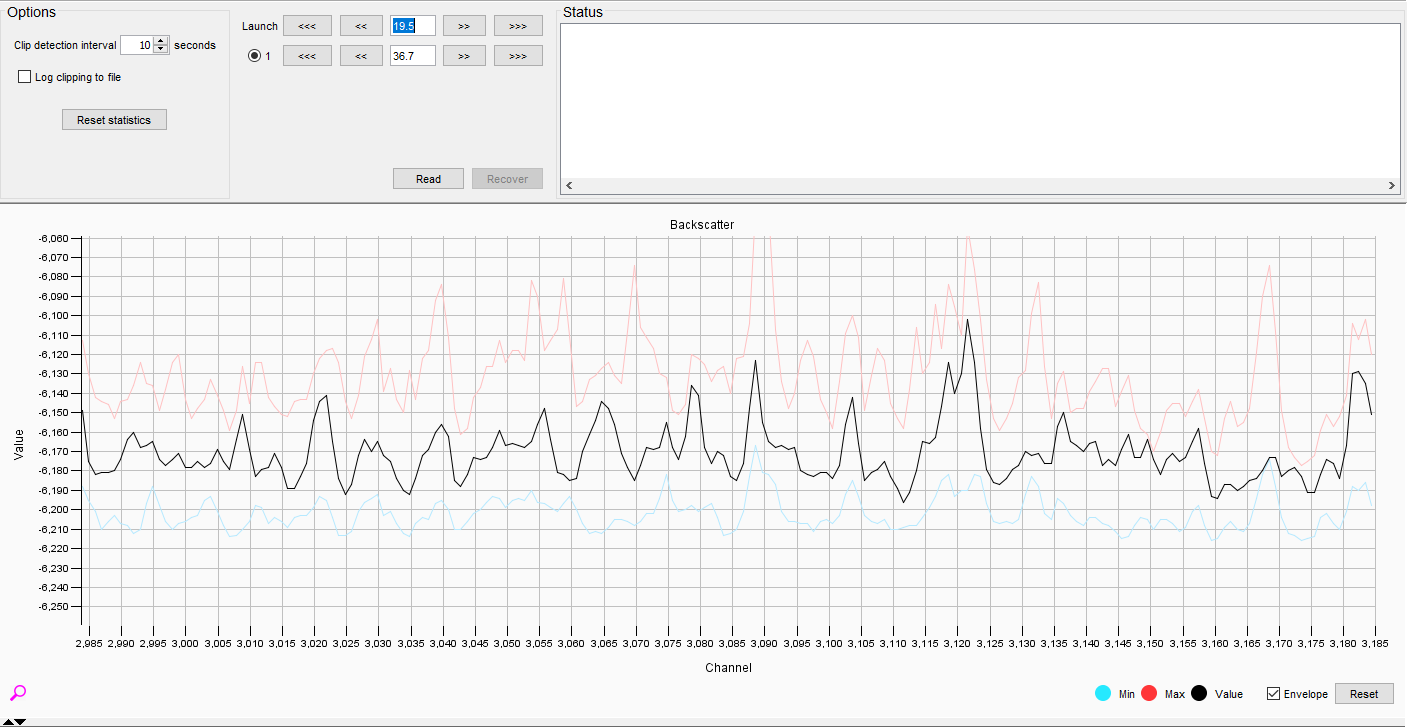
Setting the Detect Attenuator
We are now finished with launch and can set the detect attenuation level. Reset the display and zoom into the first 1,000 samples.
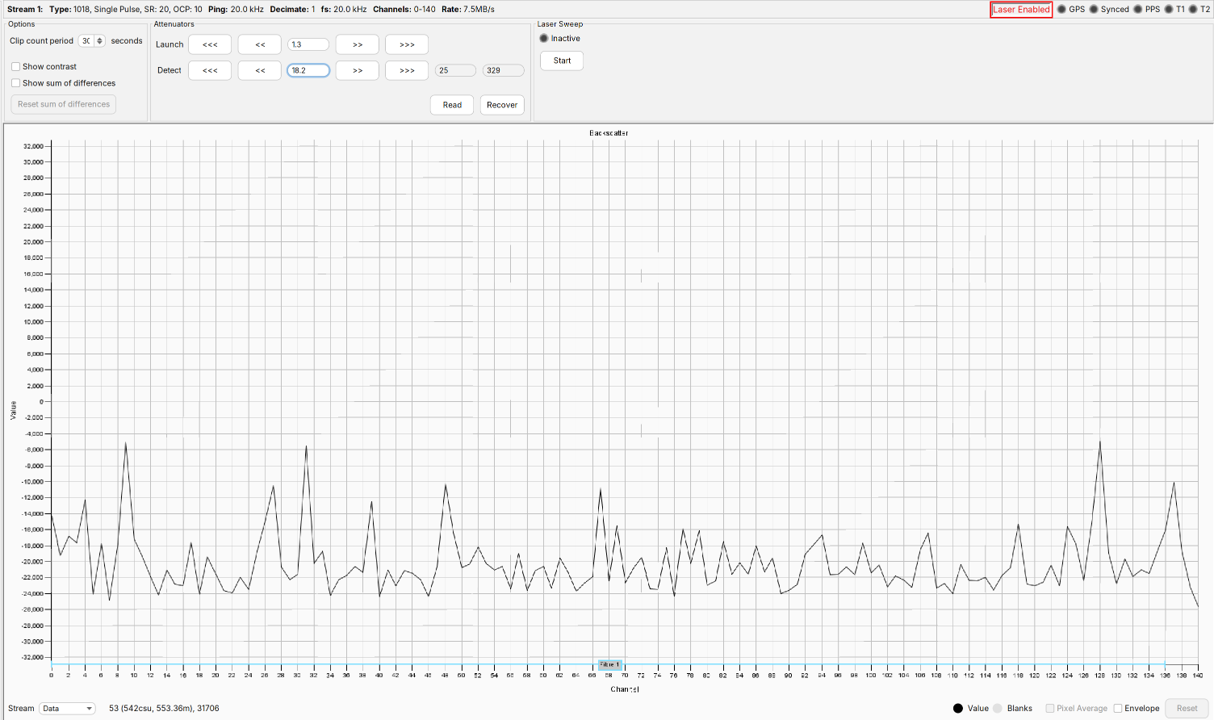
Clipping occurs when a channel is saturated and further decreases in the detect attenuation cause “flat topping” of the peaks. This effect can be seen in the figure below.
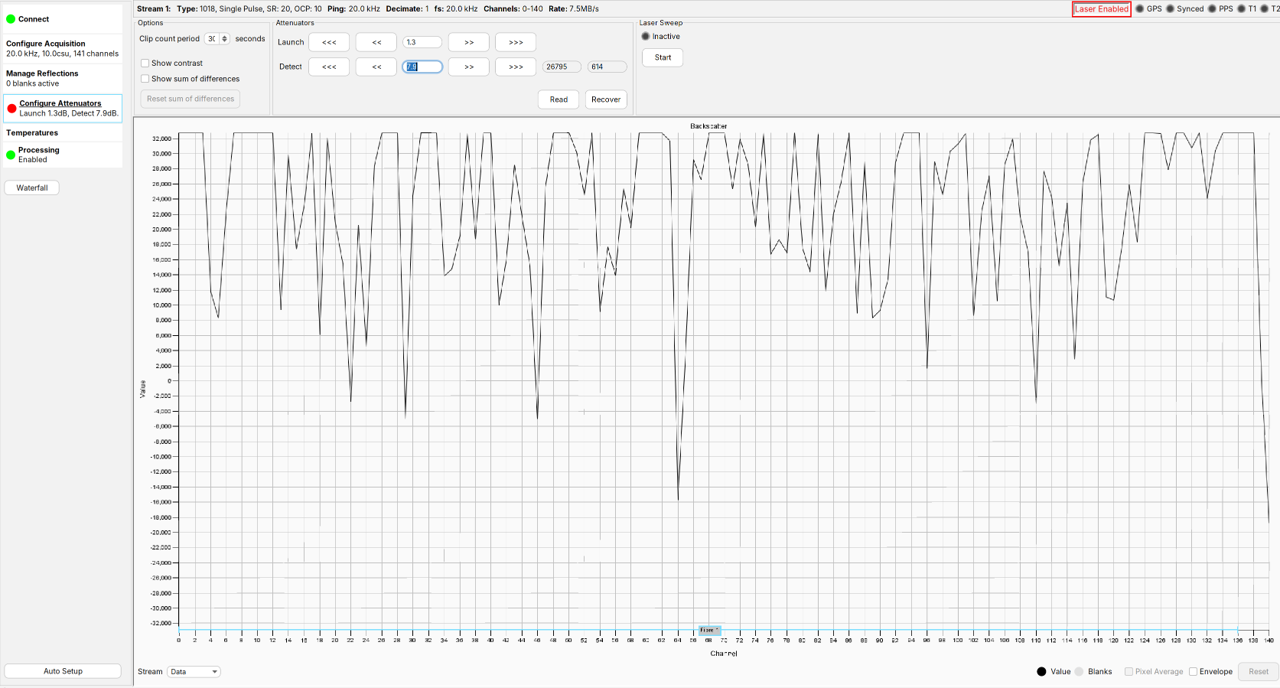
Once the detect attenuation is set correctly, the maximum peaks should be not quite clipping.
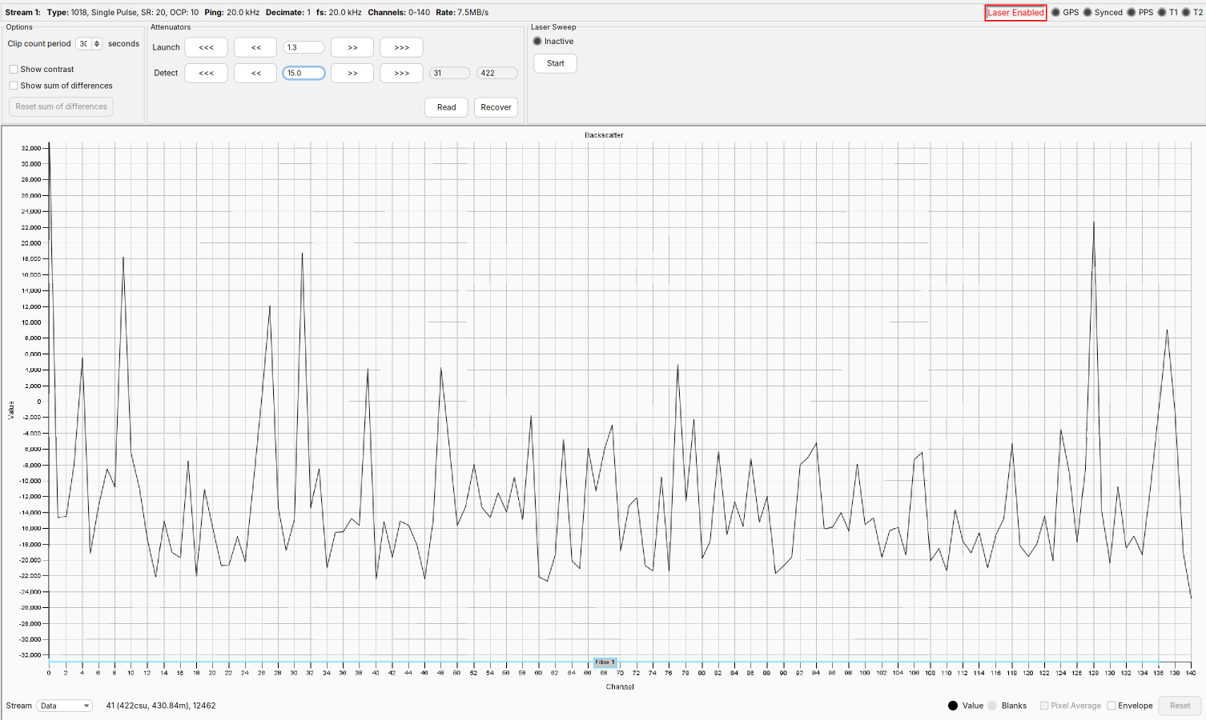
Again, to account for fading the detect attenuation should be increased a little beyond the current point. This is less of a concern than on the launch attenuator and some clipping is to be expected in a well-tuned system.
Shifting the start of acquisition along the fibre
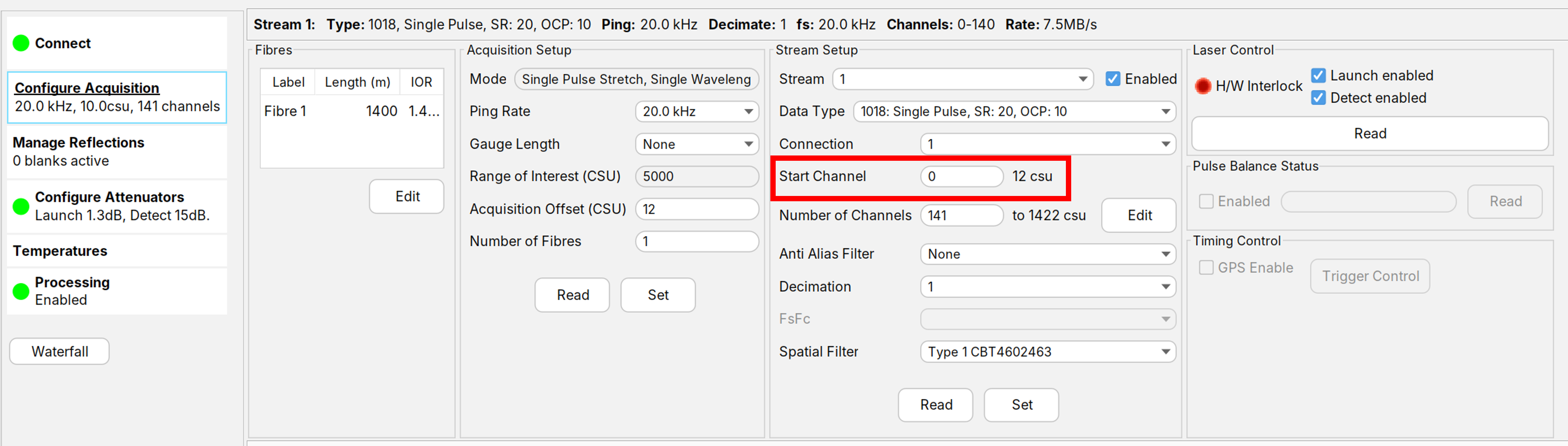
An IU can be located in varying environments; it may be housed in a remote valve station in a sparsely populated desert or may be housed in a building located in the middle of a vast industrial refinery area. For this reason, several channels at the start of the fibre may wish to be masked out as they are very noisy and in a secure area; they could distract from what the operators are looking for. In this scenario, it may be desirable to set the first acquisition point to be the first channel outside the industrial site. Alternately, there may be a long length of fibre before the region of interest and there is little point acquiring, processing and storing the data up to the region of interest.
In order to do this, it is important to identify where the data acquisition should begin by sending someone out to geo-reference and accurately locate how many channels need to be masked.
If there is 110 metres of fibre located in a noisy industrial site which the customer would like us to mask out, the start channel should be set to Channel 11. (This assumes a spatial pitch 10 metres).
Once a new start channel has been entered the Set button needs to be toggled.
Additional Information for QuantX
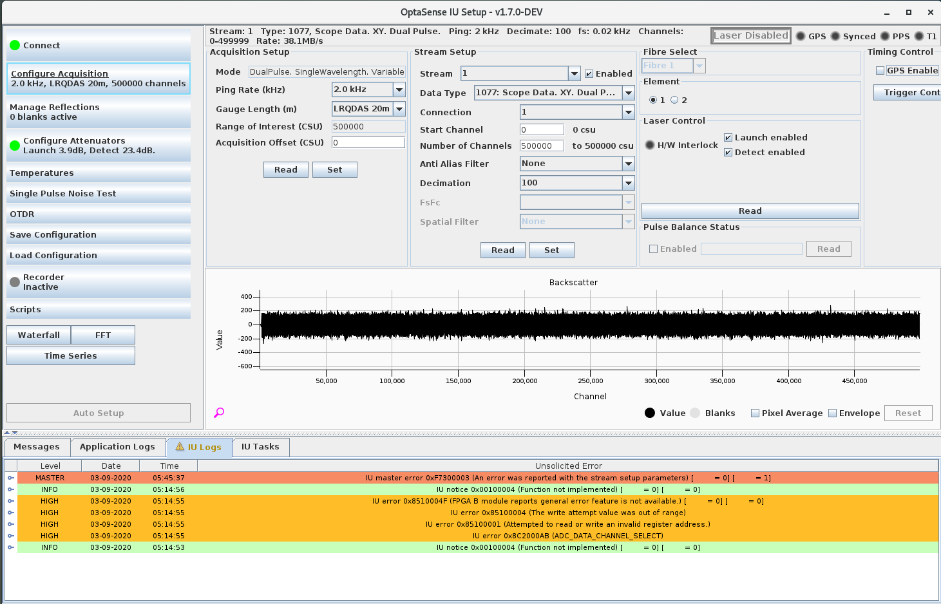
The backscatter displays are used for setting up the unit and will be blank when phase data is selected. The QuantX IU needs to be placed into Scope mode (single- or dual-carrier depending on what data will be ultimately used).
The IU should be configured with the appropriate Ping Rate and Gauge Length prior to configuring the attenuation as these parameters can affect where the point of non-linearity is seen.
The Element buttons select which diversity element is displayed and both elements need to be taken into account when identifying the optimal attenuation conditions.
Additional Information for ATLAS
The ATLAS IU provides both data and IU assurance datastreams. The Fibre Assurance stream should be used to configure the attenuators.

Fibre Assurance Stream
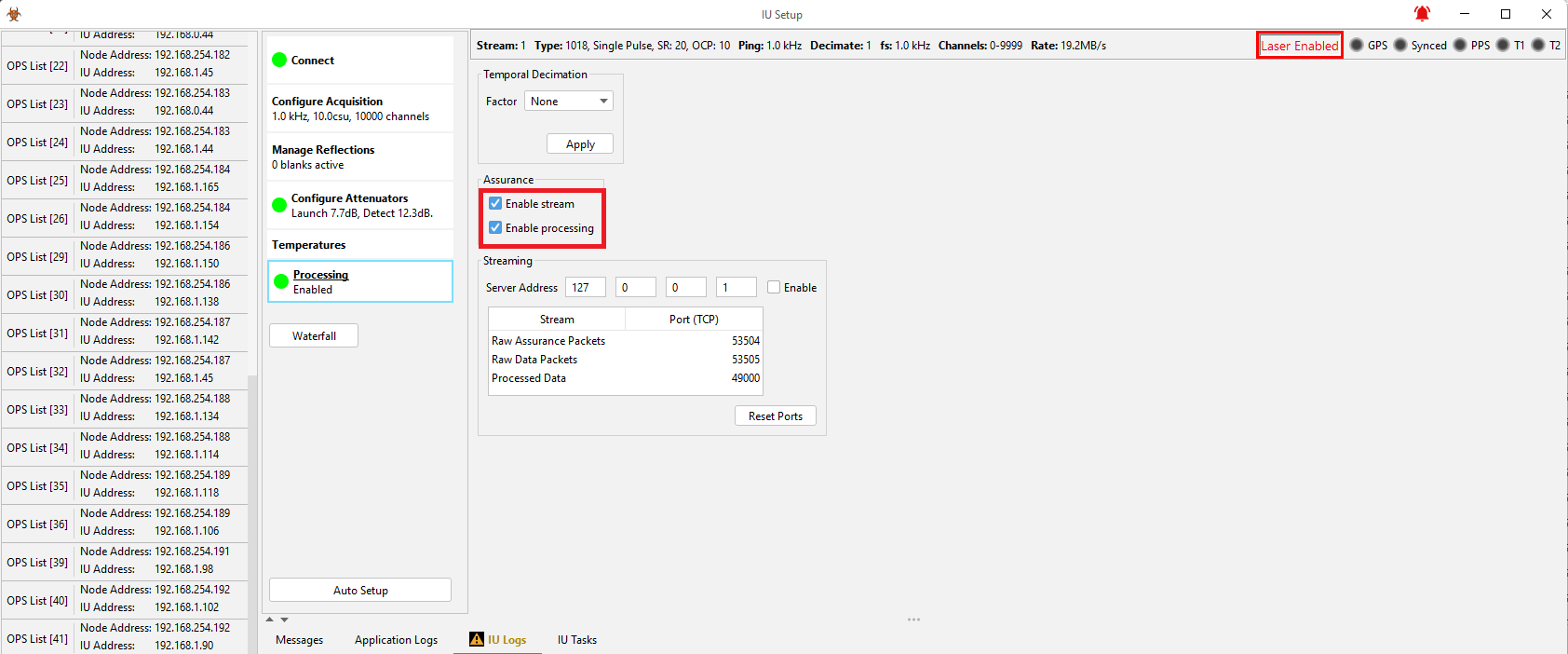
Previous versions of software have required the configuration of a fibre break detector in order to provide the ability to detect if and where a fibre break had occurred. Any version of software running IU setup 1.8 or greater contains a self-configuring fibre assurance stream (available on OLA2.1+, OLA2.2, QuantX and ATLAS). The assurance stream is enabled by checking the ‘Enable processing’ box on the IU Processing tab in IU setup.
Once checked, the IU data stream will drop out for several seconds whilst the fibre assurance stream is set up. After this point, the processing will automatically generate an alert should a loss of signal be detected anywhere along the fibre route. Once a fibre break has been detected the fibre assurance stream will need to be re-enabled once remedial works have taken place.
Temporal Decimation
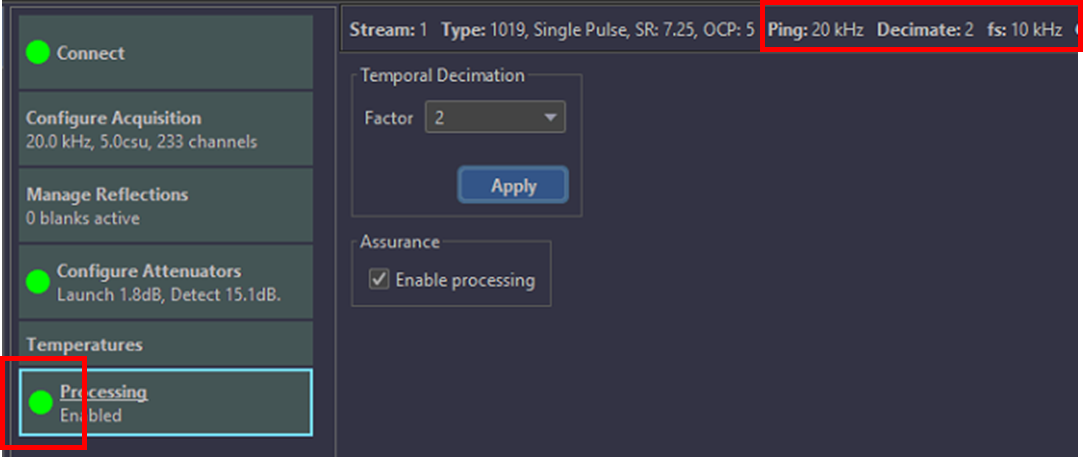
In some scenarios it may be desirable to reduce the data sampling rate without reducing the IU ping rate. For example, on a quantitative system a higher ping rate improves the strain rate that can be tracked while we may only be interested in very low frequency signals. A reduction in the data rate can be achieved by applying temporal decimation, which can be configured on the ‘Processing’ tab of IU Setup.
Once applied, the icon on the 'Processing' tab will turn green and the stream parameters will list the decimation factor and reduced sampling rate. On an ODH-F IU operating in a quantitative data mode there should always be a temporal decimation factor applied within the IU configuration of at least 4 applied owing to the way in which this system extracts phase data.